
table of content
- Autonomous AI Agents Development Services for USA Enterprises
- What Are Autonomous AI Agents Development Services?
- How Agentic AI Differs from Traditional Alternatives
- Core Components of Autonomous AI Agent Architecture
- Why Autonomous AI Agents Matter for USA Businesses
- Key Capabilities of Autonomous AI Agent
- How Autonomous AI Agent Development Works
- Autonomous AI Agent Development Services by Industry
- Choosing an Autonomous AI Agent Development Partner
- Questions to Ask Prospective Vendors
- Frequently Asked Questions


AI Agent Development Services 2026 | CodeStore Solutions
Autonomous AI Agents Development Services for USA Enterprises
Introduction
Picture this: It’s 9 PM on a Friday night. Your finance team just realized there’s a $50,000 invoice discrepancy that needs reconciliation before Monday’s board meeting. Normally, this would mean someone staying late (or coming in over the weekend) to manually trace through dozens of vendor records and payment systems.
But what if an autonomous AI agent could handle this entire investigation—cross-referencing invoices, checking payment records, identifying the discrepancy, and generating a full reconciliation report—all while you’re home having dinner?
That’s what autonomous AI agents do. They’re not just smarter chatbots or automated workflows. They’re intelligent teammates that can think through complex problems, make decisions, pull data from all your systems, and take action—all with the right guardrails in place to keep humans in control.
For USA businesses, autonomous agents have gone from “interesting technology experiment” to “this is how we’re going to compete.” If your competitors are already exploring this, don’t worry—this guide will walk you through everything you need to know, including how to implement these systems without getting overwhelmed.
What Are Autonomous AI Agents Development Services?
Autonomous AI agents are intelligent software systems that can independently pursue business objectives by breaking down complex tasks into actionable steps, making real-time decisions, and executing functions without constant human intervention.
In plain English? They’re like hiring a really smart, tireless employee who specializes in one area of your business, works 24/7, doesn’t get tired or frustrated, and can handle thousands of tasks simultaneously.

How Agentic AI Differs from Traditional Alternatives
Here’s where it gets interesting. There are a bunch of “automation” buzzwords floating around—chatbots, RPA, AI assistants—but they’re not all the same. Let me break down how autonomous agents actually differ:
Traditional Chatbots & Virtual Assistants: You know those “how can I help you?” pop-ups on websites? They’re responsive but limited. Ask them something outside their programming, and they’re stuck. They can’t do anything—they can only answer questions.
Retrieval-Augmented Generation (RAG) Systems: Think of these as extremely smart Wikipedia. Ask them a question, and they’ll find and synthesize the answer by searching through documents. But they can’t actually do anything with that information. If you ask “who approved this contract?”, they can tell you. But they can’t go update your CRM or send an email to that person.
Robotic Process Automation (RPA): RPA is the older generation of automation. It’s great at repetitive, predictable tasks—like “scan this folder for new invoices and enter them into the system.” But the moment something unexpected happens? A different invoice format, a missing field, an unusual scenario? RPA hits a wall and needs a human to take over.
Autonomous AI Agents (Agentic Systems): These are different animals altogether. They can:
- Break down a complex workflow and figure out the steps themselves
- Handle unexpected situations and adapt on the fly
- Integrate with multiple systems and make decisions based on real-time data
- Take actual actions (create orders, send emails, update records)
- Learn and improve as they go
- Do all this while humans maintain oversight and control
It’s the difference between a calculator and a CFO. The calculator follows exact rules. The CFO can think, reason, adapt, and make judgment calls.
Core Components of Autonomous AI Agent Architecture
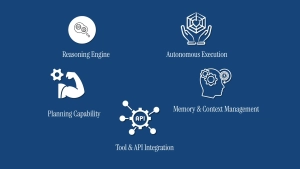
Think of an autonomous agent like a well-trained employee. Good employees need certain things to perform well, right? Here’s what autonomous agents need:
1. Reasoning Engine (The Brain) This is where the actual “thinking” happens. It’s powered by advanced AI models that can analyze a problem, consider different approaches, weigh pros and cons, and decide on the best path forward. Not just following a script—actually thinking through the situation.
2. Planning Capability (The Strategy) Your agent needs to break down a big, complex goal into smaller, manageable steps. If the goal is “reconcile this monthly budget,” the agent figures out: “First, I need to pull expenses from system A, then revenue from system B, then compare them, then flag discrepancies.” It sequences these steps logically and adjusts the plan when things don’t go as expected.
3. Tool & API Integration (The Hands) Without this, your agent would just be thinking and planning but unable to do anything. Tool integration gives the agent the ability to actually pull data from your CRM, send emails through Outlook, create records in your ERP, access databases, and take real action across all your business systems.
4. Memory & Context Management (The Experience) Imagine working with someone who forgets every conversation you’ve had with them. Frustrating, right? Good agents remember context. They recall previous interactions with a customer, remember what was discussed, understand the history, and use that to make better decisions. This is what memory and context management does.
5. Autonomous Execution with Guardrails (The Safety Net) Your agent can work independently, but not recklessly. Built-in guardrails ensure that risky decisions still require human approval, that the agent respects compliance requirements, and that you can always see what it’s doing and step in if needed.
Why Autonomous AI Agents Matter for USA Businesses
Measurable Business Impact & ROI
Here’s what we’re actually seeing in real deployments:
Time Savings (40-60% reduction): Your finance team spends 20 hours a week on invoice processing? Autonomous agents can cut that to 8-12 hours. That’s not laying people off—that’s freeing them to focus on actual analysis instead of data entry drudgery.
Error Reduction (Up to 85% fewer mistakes): Humans get tired, miss details, have bad days. Autonomous agents don’t. They process the same workflow the same way every single time. A healthcare company we worked with reduced prescription errors by 78% by using agents for medication verification.
Operational Scaling (3-5x more volume): Your customer support team handles 500 inquiries a day? With autonomous agents, you might handle 1,500-2,500 without adding headcount. The agents handle tier-1 and tier-2 questions; your people focus on the complex stuff that actually needs human judgment.
Revenue Impact (Opening new doors): One bank deployed autonomous agents for loan processing and suddenly could approve applications in 2 days instead of 2 weeks. That competitive advantage converted into $8M in additional originations in the first year—just because they could move faster.
Cost Efficiency (30-50% operational cost reduction). The bottom line? Most of our clients see 200-300% ROI within 18-24 months. That’s real money, not theoretical savings.
Market Adoption Trends in North America
Here’s the real talk: autonomous agents aren’t some fringe technology anymore. They’re becoming the standard.
65% of Fortune 500 companies are already moving on this. Not thinking about it. Not testing it. Actually piloting or deploying. That means if you’re not exploring this, you’re in the minority of large companies.
The market tells the story: It was $11.78 billion in 2026. By 2030? $93.2 billion. That’s not normal growth—that’s explosive growth. Companies don’t throw billions at something that doesn’t work.
Here’s what’s driving it: 40% of enterprise applications are expected to have autonomous agents embedded by the end of 2026. Not 4%. Not 14%. Forty percent. This is about to be everywhere.
The early adopters in finance, healthcare, and e-commerce? They’re already seeing 200-300% ROI in 18-24 months. These aren’t theoretical projections—these are real numbers from real deployments.
And here’s the interesting part: mid-market companies are jumping in faster than anyone. Why? Because a smaller company can be way more nimble. A $50M company can compete with a $500M company if they’re smarter about automation. Autonomous agents level the playing field.
Bottom line: If you’re waiting for this technology to mature or become “proven,” you’re already behind.
Competitive Advantage by Industry
Financial Services & Banking: Autonomous agents handling loan underwriting, fraud detection, and portfolio management—completing in hours what previously took days.
Healthcare & Life Sciences: Clinical workflow automation, patient intake processing, and clinical trial recruitment at scale without increasing staffing.
E-commerce & Retail: Autonomous inventory management, dynamic pricing optimization, and customer support agents resolving 70-80% of queries without escalation.
Enterprise SaaS & IT Operations: Autonomous incident response, infrastructure optimization, and security threat analysis operating 24/7.
Government & Public Sector: Automated permit processing, benefit eligibility determination, and citizen inquiry handling improving service delivery and reducing administrative burden.
Key Capabilities of Autonomous AI Agent Development Services
When you’re evaluating an autonomous agents development partner, these are the capabilities that actually matter. Not impressive marketing language—real, practical abilities that solve your problems.
Autonomous Task Planning & Execution
Imagine telling someone: “We need to process a purchase order, but I’m not going to tell you each step. Figure it out.”
A good employee would ask questions and figure out the workflow. An autonomous agent does the same thing—except it does it perfectly and consistently, every single time.
Let’s say you deploy a procurement agent. Here’s what it actually does:
“I see there’s an open purchase request for office supplies. I’ll check our vendor database, compare the top three vendors by price and delivery time. Our quality metrics show Vendor A has the best track record. They’re also 12% cheaper than Vendor B. I’ll prepare a comparison for the procurement manager, draft the PO, and flag it for approval since it’s over $5,000. I’ll also check if we have budget available this quarter…”
And it does all this while you sleep. When your procurement manager comes in Monday morning, half the work is already done.
The agent isn’t just following a checklist. It’s reasoning through the decision, considering constraints (budget, vendor performance, delivery time, pricing), and adapting when the preferred vendor is out of stock. That’s real autonomous execution.
Multi-Agent Orchestration & Collaboration
Here’s where it gets really powerful. Sometimes one agent isn’t enough. You need a whole team.
Think of it like this: You wouldn’t have one person handle sales, finance, and legal for a major deal, right? You’d have specialists. Same with autonomous agents.
We deploy multi-agent systems where:
- Agent #1 (The Researcher) pulls market data, competitor pricing, customer history—basically does reconnaissance
- Agent #2 (The Analyst) takes that data and runs it through compliance rules, financial models, risk assessments
- Agent #3 (The Executor) takes the approved recommendation and actually takes action—creating orders, updating records, sending communications
These agents talk to each other in real-time. Agent #1 says “Here’s the market data.” Agent #2 says “But compliance won’t allow that approach, try this instead.” Agent #3 takes that guidance and executes flawlessly.
Real world: A financial firm we worked with uses three coordinated agents to execute hedging strategies. One researches market data across 50+ feeds. One analyzes compliance and regulatory requirements. One executes trades with perfect precision. They work together at 2 AM on a Sunday while human traders sleep. By Monday morning, the hedge is done and performing exactly as planned.
If any agent disagrees with the others, there’s built-in governance that determines the path forward. It’s like having a perfectly functioning team where everyone communicates clearly and respects the process.
H3: Tool/API Integration & Function Calling
Autonomous agents are only as valuable as the systems they can access. We specialize in:
- Seamless API connectivity: Integrating with Salesforce, NetSuite, SAP, Workday, custom databases, and proprietary systems
- Function calling protocols: Enabling agents to invoke specific actions in connected systems (create records, send emails, update databases)
- Intelligent tool selection: Teaching agents which tool to use for which task and error handling when tools fail
- Real-time data access: Agents pulling current information from multiple sources to inform decisions
- Bi-directional sync: Systems staying synchronized as agents take actions
We’ve integrated autonomous agents with 50+ enterprise platforms across our USA-based client base, handling everything from legacy mainframe systems to cutting-edge cloud infrastructure.
H3: Memory & Context Retention Across Workflows
Unlike stateless systems, our autonomous agents maintain rich context:
- Conversation memory: Remembering previous interactions with the same user or entity
- Workflow state: Tracking progress through multi-step processes and resuming interrupted workflows
- User preferences & history: Personalizing agent behavior based on past interactions
- Knowledge persistence: Building contextual understanding of your business, industry, and specific organizational practices
- Long-term learning: Agents that improve their decision-making based on accumulated experience
This enables agents to handle nuanced, relationship-based tasks—not just transactional ones.
H3: Human-in-the-Loop Oversight & Guardrails
Enterprise-grade autonomous agents require built-in safeguards:
- Confidence thresholds: Escalating decisions to humans when certainty falls below acceptable levels
- Approval workflows: High-value or risky actions requiring human authorization before execution
- Audit trails: Complete logging of every decision and action for compliance and transparency
- Real-time monitoring: Dashboards showing agent activity, performance metrics, and anomalies
- Emergency override: Ability to pause or redirect agents if something goes awry
- Policy enforcement: Hard constraints ensuring agents never violate compliance requirements or business rules
We’ve designed guardrails that enable autonomous execution while maintaining the human oversight that enterprise governance demands.

How Autonomous AI Agent Development Works: Implementation Process
Alright, let’s walk through what actually happens when you decide to build autonomous agents. This isn’t some mysterious, opaque process. Here’s the real journey:
Phase 1: Discovery & Use-Case Scoping (2-3 weeks)
Week 1: The Getting-to-Know-You Phase
We start with conversations. Real conversations, not PowerPoint presentations. We sit down with your leadership team and ask:
- “What’s keeping you up at night? What process is eating your team’s time?”
- “Where are your biggest pain points? Where do you lose money? Where do you lose customers?”
- “What would be different about your business if you had 40% more capacity without hiring?”
Then we go observe. We watch your processes in action. Where does actual manual work happen? Where do people pull data from five different systems just to answer one question? Where do errors creep in? These aren’t technical questions—they’re workflow questions.
Week 2-3: Reality Check
We ask the hard questions:
- “Do you have good data? Are your records clean or messy?”
- “Are your systems documented or are people just ‘knowing how it works’?”
- “Is your leadership team actually bought in, or are they just being polite?”
- “What does winning look like for you? Is it speed? Cost? Quality? New capability?”
At this point, we usually identify 8-15 processes that could benefit from autonomous agents. Then comes the hard part—picking which one to tackle first.
The Pilot Selection Game
We score each potential use case against three things:
- Impact: How much money/time/quality will this actually affect?
- Feasibility: Can we actually build this in 8-12 weeks without hitting major roadblocks?
- Confidence Building: Will this success make the team more confident to tackle bigger things later?
We don’t pick the biggest, most complex thing. We pick something that’s meaningful enough to show real value, achievable quickly, and gets your team excited. Usually takes 8-12 weeks.
Phase 2: Architecture & Autonomous Agent Design (3-4 weeks)
Building the Blueprint
Now we’re in the technical weeds. Here’s what’s happening:
We’re basically asking: “If we were training someone new to do this job, what would they need to know?”
- Decision-making logic: How should the agent think through choices? “If invoice amount > $10,000, escalate for approval. If invoice matches PO exactly, approve automatically. If there’s a discrepancy, flag specific items for review.”
- Data sources: What information does the agent need? Your ERP? Vendor database? Email? Historical patterns? We map all of it.
- Memory: What should the agent remember? Previous vendor interactions? Customer history? Budget spend-to-date?
- Guardrails: What are the hard rules? “Never approve without manager confirmation if amount exceeds budget.” “Always check compliance database before approving international transactions.”
- Escalation logic: When should humans step in? Confidence thresholds, dollar limits, complexity triggers—we define all of it.
The Training Data Game
Your historical data is gold. We collect your last 12-24 months of decisions on this process:
- What did your team approve/reject?
- Why did they make those decisions?
- What were the outcomes?
- What edge cases caused problems?
We use all this to “teach” the agent. Not just rules—we’re showing it patterns of good decision-making.
Technology Choices
We pick the right tool for the job. Different language models (GPT-4, Claude, specialized models) excel at different things. We choose what works best for your specific use case, not what’s trendiest.
Phase 3: Integration with Existing Enterprise Systems
API & System Connectivity (4-6 weeks)
- Establish secure connections to required business systems (CRM, ERP, databases, etc.)
- Implement robust authentication and authorization
- Build error handling and retry logic for API calls
- Create data transformation layers if systems use incompatible formats
Data Preparation & Governance
- Standardize data formats across connected systems
- Implement data quality checks and validation
- Establish data residency and privacy compliance (HIPAA, SOC 2, etc.)
- Create feedback loops to improve agent performance
Testing Integrations
- Simulate end-to-end workflows with real system data
- Test failure scenarios and recovery procedures
- Validate security measures and access controls
- Conduct load testing to ensure system can scale
Phase 4: Testing, Guardrails & Deployment
Comprehensive Testing (4-8 weeks)
- Unit testing of individual agent components
- Integration testing across connected systems
- Scenario testing using real historical workflows
- Adversarial testing to identify failure modes and edge cases
- Performance testing under expected load
Guardrail Implementation & Validation
- Configure confidence thresholds for automatic escalation
- Set up approval workflows for high-risk or high-value actions
- Establish monitoring dashboards and alert systems
- Define escalation procedures and human review processes
Controlled Rollout
- Shadow mode: Agent runs decisions without taking action; humans validate
- Limited deployment: Agent operates on subset of transactions with strict limits
- Graduated expansion: As confidence increases, expand scope and autonomy
- Full production: Agent operates at full capacity with ongoing monitoring
Timeline & Investment (4-6 Months, Realistic Costs)
The Honest Timeline
Most of our clients go from kickoff to live agent in about 4- 6 months. Here’s how it breaks down
That 4-6 month timeline assumes you’re focused on one solid use case, not trying to boil the ocean.
Who’s Involved?
From our side:
- A project manager keeping everyone sane and on track
- 2-3 AI/ML engineers doing the actual building
- A systems integration expert connecting everything
- A security/compliance person (especially important for regulated industries)
- QA specialists breaking things intentionally to find problems before they matter
From your side:
- Business stakeholders who actually know how the process works today
- Someone who understands your data
- IT folks who understand your systems
- An executive sponsor keeping it prioritized when other stuff demands attention
Real Money Talk
- Pilot project: $80K – $150K (one solid use case, prove the concept)
- Enterprise implementation: $250K – $500K (more complexity, more systems to connect)
- Multi-agent platform: $500K – $1.5M+ (building a whole ecosystem)
What drives costs up?
- Messy data (requires more cleanup)
- Lots of system integrations (each one takes time)
- Heavily regulated industry (compliance costs money)
- Complex decision logic (takes more time to get right)
Honestly? If your vendor quotes you the same price regardless of your complexity, they’re either lowballing or don’t understand the project. Real projects vary because real situations vary.
Autonomous AI Agent Development Services by Industry (USA)
Financial Services & Banking
The Real Problem
Mortgage underwriting is brutal. You have a person sitting there manually reviewing applications, pulling credit reports, verifying income documentation, checking appraisals, running risk models. It takes weeks. Applicants get frustrated. Good loans slip through (because the underwriter was tired). Bad loans slip through (because the underwriter missed something).
What an Autonomous Agent Does
An agent processes the application from start to finish:
- Pulls credit reports automatically
- Verifies income against tax returns and employment records
- Checks appraisal databases
- Runs risk models
- Flags anything unusual for human review
- Pre-prepares the decision documentation
Real Numbers: A regional bank we worked with saw 60% faster processing and 23% fewer defaults. Why fewer defaults? Because the agent never gets tired or distracted. It checks everything consistently.
The Complication Banking industry is heavily regulated (SEC, FDIC, OCC). That means the guardrails have to be tight. The agent can’t be cavalier. But done right, compliance actually becomes easier because everything’s audited and logged.
Healthcare & Life Sciences
The Real Problem
Your clinic gets 200 patient intake forms a day. Each one needs to be reviewed, verified, flagged if anything’s abnormal. That’s someone’s full-time job—and they’re always drowning.
What an Autonomous Agent Does
- Processes intake forms
- Extracts relevant medical history
- Flags red flags (drug interactions, contraindications, previous conditions that matter)
- Pre-populates patient records
- Schedules appropriate follow-ups
- Alerts clinicians to anything that needs immediate attention
Real Numbers: A health system reduced appointment no-shows by 34% because the agent intelligently rescheduled and reminded patients. Seems like a small thing, but that’s huge for patient care and revenue.
The Complication: HIPAA is serious business. Patient privacy is non-negotiable. Any agent handling health data needs enterprise-grade security and compliance.
E-Commerce & Retail
The Real Problem
You’re running an e-commerce platform. A competitor just dropped prices. You need to adjust yours to stay competitive. But you also can’t destroy margin. And you have 50,000 SKUs. You can’t do this manually.
What an Autonomous Agent Does
- Monitors competitor pricing across platforms
- Analyzes your cost basis, margin targets, inventory levels
- Makes pricing decisions in real-time
- Flags items that need human review (brand items with margin floors, clearance items, etc.)
- Optimizes for profit, not just volume
Real Numbers An e-commerce client increased profit margins by 18% while staying competitive on pricing. They didn’t raise prices—they just made smarter decisions faster.
The Complication High transaction volume. Real-time decisions. Zero tolerance for downtime. The agent infrastructure has to be bulletproof.
Healthcare & Life Sciences
Common Use Cases:
- Patient intake and medical history processing
- Clinical workflow optimization
- Appointment scheduling and patient coordination
- Clinical trial recruitment and enrollment
- Insurance authorization and billing automation
- Research data analysis
Client Example: A health system implemented an autonomous scheduling agent that reduced appointment no-shows by 34% through intelligent rescheduling and patient reminders.
Industry Challenges: HIPAA compliance, patient privacy, medical accuracy requirements, integration with legacy clinical systems.
E-Commerce & Retail
Common Use Cases:
- Dynamic pricing optimization
- Inventory management and reorder automation
- Customer support and returns processing
- Personalized product recommendations
- Demand forecasting
- Supplier relationship management
Client Example: An e-commerce platform deployed autonomous pricing agents that increased profit margins by 18% while maintaining competitive positioning through real-time market analysis.
Industry Challenges: High transaction volume, real-time decision requirements, inventory complexity, customer experience expectations.
Enterprise SaaS & IT Operations
The Real Problem
Your infrastructure breaks at 3 AM on a Sunday. Your on-call engineer gets paged. By the time they wake up, troubleshoot, and escalate, it’s been down for 30 minutes. Revenue is hemorrhaging.
What an Autonomous Agent Does
- Detects anomalies automatically
- Runs diagnostic checks
- Attempts common fixes (restarts, scaling, failover)
- Escalates to humans only if it needs judgment
- Updates tickets, notifies stakeholders, tracks resolution time
Real Numbers A SaaS platform reduced their mean-time-to-resolution from 45 minutes to 8 minutes. That’s the difference between “oh no, our site was down” and “we had an incident but nobody noticed.”
The Complication You can’t afford to be wrong. Security matters. Uptime matters. The agent has to be cautious by design.
Government & Public Sector
The Real Problem
Permit processing takes 6 weeks. People are frustrated. Government agencies are backlogged. Simple permits sit in queues because someone has to manually review applications, verify documents, check compliance.
What an Autonomous Agent Does
- Verifies documents automatically (checks signatures, dates, required fields)
- Checks against compliance databases
- Flags applications that don’t meet requirements
- Auto-approves applications that meet all criteria
- Escalates edge cases to actual humans who make judgment calls
Real Numbers A state agency got permit processing down from 6 weeks to 3 days. People still get the same review—it’s just not bogged down in bureaucratic delays.
The Complication Transparency is critical. People have the right to know why their application was approved or denied. Every decision needs to be auditable and explainable. You can’t just have a black box making government decisions.
Choosing an Autonomous AI Agent Development Partner (USA)
Alright, this is where most people get nervous. How do you actually choose a good vendor? What separates the real players from the hype-artists?
Capability & Feature Comparison Framework
Here’s what actually matters when you’re evaluating vendors:
Model Selection & Flexibility You want a partner who has options, not someone committed to one specific LLM. Why? Because different models excel at different things. One model might be great for reasoning but slower at coding. Another excels at instruction-following but hallucينates more. A good partner picks the right tool for your job, not the one they’re most comfortable with.
Red flag: “We use GPT-4 for everything.” That’s lazy. Not always appropriate.
Integration & API Connections How many systems can they connect to? Do they have pre-built connectors for Salesforce, NetSuite, SAP? Or are you paying consulting rates while they build custom integrations for every system you have?
Real talk: Some integration work is always custom. But a vendor who’s done this 100+ times has solved most common integration problems already. You’re not their R&D project.
Security & Compliance Credentials Non-negotiable for enterprise:
- SOC 2 Type II: This is the serious stuff. An independent audit over 6+ months verifying they actually have controls over security, availability, and privacy.
- ISO 27001: International standard for security management.
- HIPAA/FedRAMP: If you’re in healthcare or government, this is required, not optional.
Red flag: If they don’t have SOC 2 Type II and you’re considering them for anything sensitive, walk away.
Scalability & Performance Can they handle your volume? Have they proven they can manage millions of transactions reliably? Do they have SLA guarantees?
Real talk: They should have case studies showing they handle your level of scale. Not “we can scale” but “we have scaled for companies like you.”
Monitoring & Observability You need dashboards showing what your agents are doing. Audit logs showing every decision. Real-time alerts when something’s wrong. This shouldn’t be an afterthought—it should be built in from day one.
Red flag: If they can’t clearly show you how you’ll monitor agent performance, that’s a problem.
Customization & Specialization Can they fine-tune models? Build agents specialized for your industry? Or are you getting generic, off-the-shelf agents?
Real talk: Generic agents work for generic problems. Anything meaningful requires customization.
Pricing Models (USD)
Vendors will charge you in different ways. Here’s the honest breakdown:
Project-Based (Fixed Price) “$300,000 for this agent. Done deal.”
Best for: You know exactly what you want and the scope is clear.
Real cost: $100K – $1M depending on complexity. You know the price upfront—that’s the good news.
The catch: If scope changes, prices change. If your team keeps asking for “one more thing,” you’re either paying more or the vendor is unhappy. This model works when you’ve truly nailed down requirements.
Time & Materials (Pay by Hour) “We’ll charge $150-300/hour for engineers.”
Best for: You’re not totally sure what you need yet. You expect evolution during the project.
Real cost: $150-300/hour × however many hours it takes. Could be $200K. Could be $600K. Depends on complexity.
The good news: Flexibility. If you discover something during development, you’re not renegotiating a fixed contract.
The catch: Cost uncertainty. Some vendors are good at estimating. Some… aren’t.
Success-Based / Revenue Share “We’ll take 20% of the savings we generate.”
Best for: You’re confident there’s real ROI but want alignment with outcomes.
How it works: If the agent saves you $500K/year, they take $100K. Your actual cost = outcomes-based.
The good news: If it doesn’t work, they don’t get paid much. Maximum alignment.
The catch: Requires trust and clear ROI metrics. Some vendors overpromise on savings to make this work. Also, you’re giving away a piece of the upside forever. That $500K savings is their money and your money.
Managed Services / Subscription Model “$10K/month to keep your agents running and optimized.”
Best for: You want ongoing support, continuous improvement, and predictable costs.
Real cost: $5K-50K/month depending on complexity and scale. You’re basically hiring a part-time team.
The good news: Predictable. They have incentive to keep things running well because you can cancel anytime.
The catch: This is an ongoing cost. Not ideal for a one-off project.
In-House vs. Outsourced Development
Build In-House If:
- You have specialized ML/AI talent on staff
- You have urgent timelines and can dedicate full teams
- Your use case is highly proprietary and differentiated
- You want complete control over intellectual property
- You plan to develop multiple agents over time
Challenges: High talent costs ($200K-300K+ annual salary for specialists), long ramp-up time, opportunity cost of diverting resources from core business.
Outsource If:
- You lack specialized AI talent or can’t compete on salary
- You want to minimize implementation risk
- You need to accelerate time-to-value
- You prefer predictable project costs
- You want to leverage partner’s experience across multiple clients
Hybrid Approach (Recommended for Most):
- Partner handles agent architecture, development, and deployment
- Your team manages change management, process redesign, and stakeholder alignment
- Builds internal capability while accelerating implementation
- Enables knowledge transfer and eventual in-house management
Critical Questions to Ask Prospective Vendors
Why it matters: Anyone can talk about the potential. You want to hear about actual deployments. How many agents have they shipped? What were the real outcomes?
What to listen for: Specific numbers. “We reduced processing time by 60%.” “We handled 3x volume without headcount increase.” Not vague promises—actual metrics from actual clients.
“Show me real results from production agents you’ve deployed.”
Why it matters: Deployment nightmares are where character shows. Anyone can build something that works perfectly in testing. Real partners have procedures for when things break.
What to listen for: They should have specific examples of problems they’ve hit and how they fixed them. They should acknowledge that agents DO make mistakes sometimes. If they claim 100% accuracy, they’re lying.
“Red flag: We’ve never had a major issue.” — Everyone has had issues. The question is how they handled it.
Why it matters: If you’re in healthcare, finance, or government, this isn’t optional. Your data can’t be stored on some random server in a random country.
What to listen for: They should clearly explain where data lives, how it’s encrypted, who can access it, and how they handle compliance requirements.
“Red flag: We’ll figure it out during the project.” — You need this locked down before day one.
Why it matters: System integration is usually where timelines explode. If they’ve never integrated with your core systems, expect delays.
What to listen for: They should have done it before. Multiple times. And they should be honest about common gotchas.
“Red flag: It’s just an API call.” — Naive. Every enterprise system has quirks. If they haven’t faced your specific systems, costs and timeline will be higher.
Why it matters: You need visibility. If something goes wrong, you need to know immediately. You need to see audit trails for compliance.
What to listen for: They should be able to show you a real dashboard (or similar) from another client. You should see clear metrics, decision logs, performance indicators.
Red flag: “We’ll build dashboards during the project.” This should be standard. It shouldn’t be custom work.
Why it matters: Most agents improve 15-25% over the first 6 months as you refine guardrails, fix edge cases, and improve training data. The vendor should have a structured approach to this.
What to listen for: Do they plan to monitor performance? Review decisions? Identify where the agent is struggling? Iterate on improvements?
“We’ll build dashboards during the project.” — This should be standard. It shouldn’t be custom work.
Why it matters: Experience in your industry matters. A vendor who’s done 50 loan automation projects understands banking differently than someone who’s done 50 random projects.
What to listen for: Customers at similar scale, similar industry, similar complexity. Not just any reference—ones that are relevant to you.
All their references are tiny companies (if you’re enterprise) or all their references are in different industries — they might not understand your specific challenges.
Why it matters: This separates confident vendors from people just after your money.
What to listen for: Most good vendors will offer some kind of remediation—extra optimization work, additional tuning, etc. They should take some responsibility for outcomes.
“ROI targets are your responsibility.” — Well, yes, but a good partner helps you hit them. If they have no skin in the game, that’s suspicious.
Compliance, Security & Governance
SOC 2 Type II & ISO 27001 Requirements
SOC 2 Type II Compliance:
- Demonstrates controls over security, availability, processing integrity, confidentiality, and privacy
- Requires an independent audit over a 6+ month period
- Critical for handling sensitive business data
- Essential for partnerships with major enterprises
ISO 27001 Certification:
- International standard for information security management
- Covers asset management, access control, incident response, and risk management
- Required by many regulated industries
- Shows commitment to continuous security improvement
Look for vendors that achieve both certifications with current audit reports.
Data Residency & Privacy Compliance
Key Compliance Mandates:
- GDPR: For any data connected to European individuals
- HIPAA: For healthcare providers and health plans
- FedRAMP: For federal government systems
- CCPA/CPRA: For California resident data
- Industry-Specific: SOX (financial), PCI-DSS (payment processing), FISMA (government)
Vendor Requirements:
- Ability to deploy autonomous agents in specific geographic regions
- Encryption of data in transit and at rest
- Documented data handling procedures
- Regular security audits and penetration testing
- Incident response procedures and notification protocols
Enterprise-Grade Guardrails for Autonomous Agents
Critical Safeguards:
- Action Validation: High-risk actions (transfers, deletions, external communications) require explicit human approval before execution
- Confidence Thresholds: If an agent’s confidence in a decision falls below a defined threshold (typically 80-90%), escalate to human for review
- Financial Limits: Set transaction limits that agents can execute autonomously; exceed limits trigger approval workflows
- Audit Logging: Complete record of every agent action—what decision was made, why, what was the outcome—for compliance and troubleshooting
- Rate Limiting: Prevent runaway agents from overwhelming systems or executing too many actions simultaneously
- Policy Enforcement: Hard constraints that agents cannot violate regardless of reasoning (e.g., “never modify contracts without legal review”)
- Regular Review: Weekly or monthly analysis of agent decisions, outcomes, and edge cases that could inform guardrail refinements
Human Oversight & Audit Trails
Audit Trail Requirements:
- Every decision logged with timestamp, reasoning, input data, and outcome
- Changes to agent behavior or configuration tracked with approval
- Performance metrics and anomalies flagged for human investigation
- Compliance-ready reporting for regulatory audits
Human Review Processes:
- Daily/weekly monitoring dashboards showing agent activity and performance
- Automated alerts for anomalies, errors, or policy violations
- Monthly reviews analyzing patterns and identifying optimization opportunities
- Quarterly business reviews ensuring agents continue meeting objectives
Frequently Asked Questions
Final Recommendations: Adopting Autonomous AI Agents Successfully
Summary of Key Benefits
Autonomous AI agent development represents a fundamental shift in how enterprises operate:
- Speed & Scale: Accomplish in hours what previously took days or weeks, without proportional headcount increase
- Consistency & Quality: Eliminate human error and variability through systematic decision-making
- Cost Efficiency: Reduce operational expenses by 30-50% depending on process and industry
- New Capabilities: Enable business models and customer experiences previously impossible with manual processes
- Competitive Advantage: Operate faster and more intelligently than competitors still relying on manual workflows
The organizations thriving in 2026 are those embedding autonomous agents into core operations, not treating them as experimental projects.
Best Practices for Adoption
1. Start with Quick Wins
- Choose a use case with clear business impact, manageable scope, and high probability of success
- Typical timeline: 4-6 months from kickoff to production
- Build organizational confidence and internal capability before expanding
2. Secure Executive Alignment
- Autonomous agents require organizational change, not just technology change
- Ensure clear executive sponsorship and resource commitment
- Define business case with specific ROI targets and success metrics upfront
3. Prepare Your Data & Systems
- Clean, consistent data is a prerequisite for effective agents
- Ensure existing systems have documented APIs and clear integration pathways
- Conduct security and compliance audits to identify constraints
4. Invest in Change Management
- Communicate clearly about agent capabilities and limitations
- Involve affected teams in design to build buy-in
- Provide training on interacting with autonomous systems
- Establish feedback mechanisms to continuously improve agent performance
5. Plan for Scale
- Design initial implementation with expansion in mind
- Create playbooks and frameworks for deploying subsequent agents faster
- Build internal expertise through knowledge transfer from development partner
6. Maintain Human Oversight
- Establish monitoring dashboards and escalation procedures
- Review agent performance regularly and refine guardrails
- Keep humans in the loop for high-stakes decisions
- Document everything for compliance and learning
Next Steps: Getting Started
Immediate Actions:
- Assess Your Readiness: Review your top 5 business processes. Which could benefit most from automation? Which have sufficient data volume to support an agent? Which face the least organizational resistance?
- Identify Your Partner: Look for vendors with proven production experience, specific industry expertise relevant to your business, and enterprise-grade compliance credentials. Ask for references from companies similar to yours.
- Define Your Pilot: Select a single high-impact use case with moderate complexity. Develop a business case with specific success metrics. Plan a 4-6 month implementation.
- Secure Commitment: Ensure executive sponsorship and dedicated business stakeholder participation. Autonomous agents require organizational engagement, not just technology work.
Your enterprise is ready to explore autonomous AI agents. Whether you’re evaluating feasibility, planning a pilot, or ready to implement—we’re here to guide you.
Why Partner With Us for Autonomous AI Agent Development
- 100+ enterprise autonomous agent deployments across the USA spanning financial services, healthcare, e-commerce, and government
- Production-proven implementations with average time-to-value of 4.5 months and 240% median ROI
- Industry-specific expertise in regulated industries (healthcare, finance, government) with deep compliance knowledge
- Hands-on approach combining development excellence with genuine business outcome focus
- Post-deployment support including managed optimization, continuous monitoring, and expansion guidance