
table of content
- Introduction to AI Agents vs. Automation
- Automation vs. AI Agents: The Real Difference
- When Automation Is Actually the Better Call
- When You Actually Need an AI Agent
- What This Actually Costs You (Beyond the Build)
- The Governance Question Nobody Wants to Deal With But Should
- Where This Actually Plays Out: Industry by Industry
- How We Approach This at CodeStore
- So, Which One Do You Actually Need?


AI Agents vs. Automation: What USA Businesses Actually Need to Know
Introduction to AI Agents vs. Automation
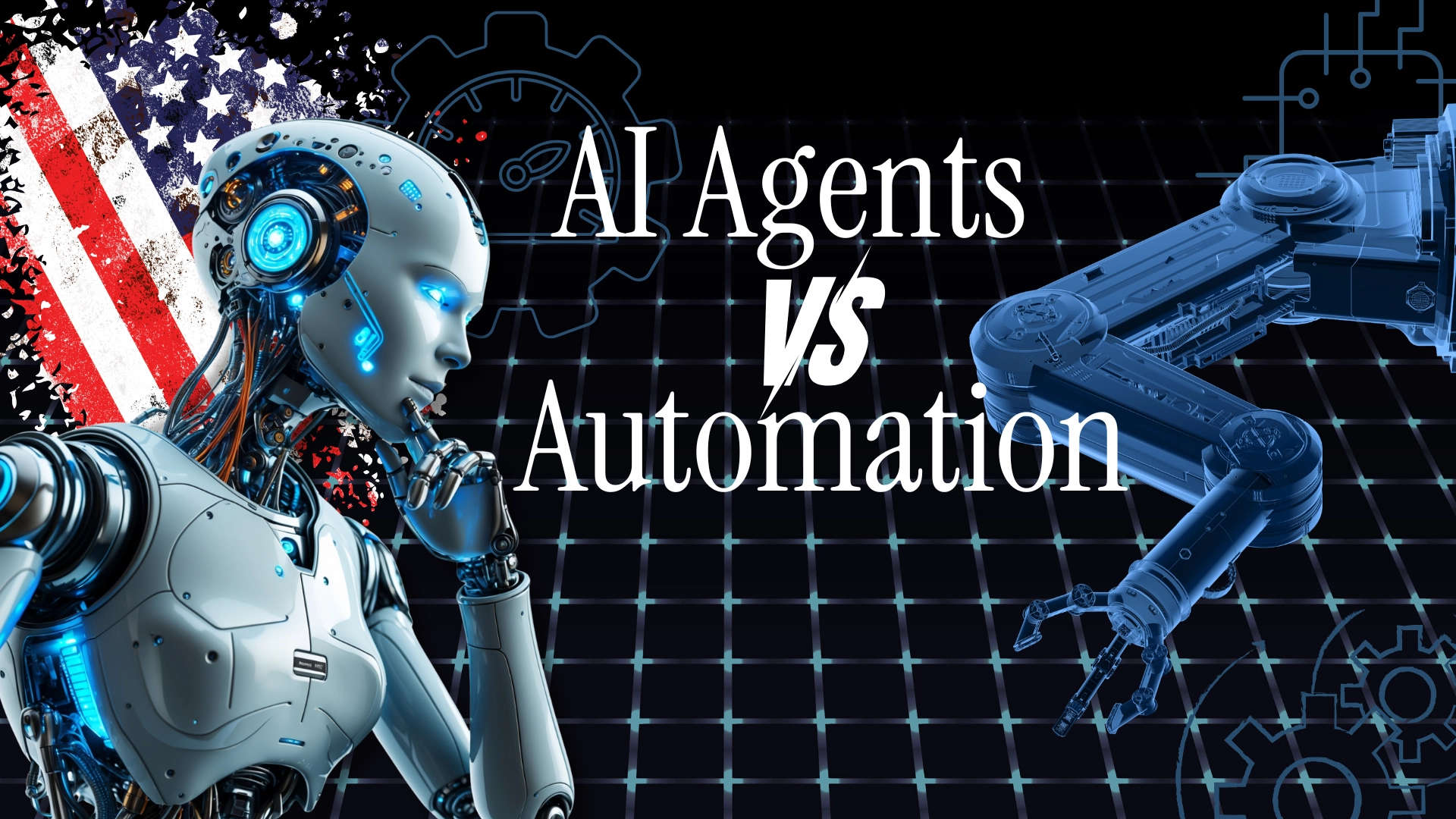
Every few months, a new term shows up in the AI conversation and everyone starts using it often before anyone agrees on what it actually means. “AI agent” is the latest one. Right now it gets slapped on everything from a basic chatbot to a fully autonomous system that plans its own next move. That’s confusing if you’re the one trying to decide what to actually build or buy.
So let’s clear it up in plain terms: what’s the real difference between automation and an AI agent, when do you actually need one over the other and what does it look like to implement either one the right way? If you’re running a business anywhere in the US and trying to figure out where AI fits into your operations this is the breakdown that should save you a lot of guessing.
Automation vs. AI Agents: The Real Difference
Automation follows instructions. You tell it exactly what to do, in what order, and it does that — every time, the same way, fast and reliable. That’s great when the process itself never changes. Think: send an invoice reminder every 30 days, route a support ticket to the right queue, back up a database nightly.
An AI agent works differently. Instead of following a fixed script, it’s given a goal — and it figures out the steps to get there. It can look at new information, make a judgment call, adjust course if something unexpected happens, and pull in other tools or systems along the way. It’s less “follow these steps” and more “here’s what I need done, go handle it.”
Neither one is automatically the better choice. That’s the part a lot of vendors skip over when they’re trying to sell you the shiniest option. The right answer depends entirely on the problem you’re solving.
We’ve seen this play out directly with our own clients at CodeStore. One team came to us wanting a fully autonomous agent for a task that, once we dug into it, just needed a well-built automation pipeline — same result, a fraction of the cost and complexity, live in weeks instead of months. That’s the conversation worth having before any development starts: do you need an agent, or do you need automation that’s just designed properly?
When Automation Is Actually the Better Call

AI Automation
If a process is repetitive, predictable, and doesn’t require judgment calls, automation usually wins — and it’s not a consolation prize; it’s the smarter engineering choice. It’s faster to build, cheaper to run, and far easier to predict. When something needs to happen the exact same way every single time — payroll processing, appointment reminders, data syncing between two systems — that consistency is the whole point.
Automation also wins on speed. A rules-based system responds in milliseconds. An agent that has to reason through a decision, call a few tools, and check its own work takes longer. If your process is time-sensitive — checkout flows, live chat triage, anything customer-facing where delay costs you the sale — that latency gap matters.
When You Actually Need an AI Agent
Agents earn their complexity when a process genuinely can’t be scripted in advance — when every case is a little different, and someone (or something) needs to actually weigh the situation and decide what to do next.
A few signs you’re in agent territory:
- The task involves judgment, not just steps. Qualifying a sales lead, triaging a complex support case, or pulling together a research summary from scattered sources — these don’t follow one fixed path.
- Inputs change constantly. If the “correct” next step depends on real-time data that’s different every time, a fixed script breaks down fast.
- The workflow spans multiple systems. An agent that can call your CRM, check inventory, and draft a follow-up email in one motion replaces what used to be three separate manual steps.
- You need it to improve over time. Agents that get feedback on their decisions can adjust — automation can’t do that on its own.

What This Actually Costs You (Beyond the Build)
Here’s the part that gets glossed over in a lot of pitches: agent systems cost more than just the build. Every reasoning step is an extra API call. Every extra call is extra latency, extra spend, and one more thing that can go wrong. A multi-agent system — several agents working together on one workflow — can run 5 to 10 times the infrastructure and operating cost of a simpler automated pipeline, once you factor in inference, monitoring, and the human oversight needed to keep it safe.
That’s not a reason to avoid agents. It’s a reason to be honest about when they’re worth it. The businesses that get the best ROI from agentic AI are the ones who start with one narrow, high-value process — not the ones who try to make everything autonomous on day one.
The Governance Question Nobody Wants to Deal With But Should
The more independence you hand a system, the more oversight it needs — not less. That trade-off surprises a lot of teams. An agent making its own decisions needs:
- Clear ownership — someone accountable for what the agent does, every time
- Defined limits — what data it can touch, what actions it’s allowed to take without a human sign-off
- Oversight that scales with autonomy — the more independent the agent, the more monitoring it needs, not less
- Audit trails — not just what the agent did, but why it made that call
Skip this step, and you’re not saving time — you’re just moving the risk further down the road, where it’s harder to catch and more expensive to fix.
Where This Actually Plays Out: Industry by Industry
- Healthcare — automation handles appointment reminders and claims routing reliably; agents step in for patient triage support that needs to weigh multiple factors at once
- Finance — automation runs recurring reporting and reconciliation; agents handle fraud investigation, where every case looks a little different
- Retail & E-commerce — automation manages inventory syncing; agents handle personalized customer service and dynamic pricing that reacts to real-time demand
- Sales & Marketing — automation sends the same follow-up sequence to everyone; agents qualify leads based on actual conversation context and prioritize follow-ups accordingly
- Real Estate — automation schedules showings; agents match buyers to listings based on shifting preferences and market conditions
How We Approach This at CodeStore
We don’t start every AI conversation by pitching agents — because half the time, that’s not actually what the business needs. Our process starts with mapping the actual workflow: where’s the bottleneck, does it require judgment or just consistency, and what’s the simplest system that solves it well.
From there, we’ve helped clients cut manual processing time by 45% on specific high-friction workflows — not by throwing the most advanced AI at the problem, but by correctly identifying where automation was enough and where an agent actually earned its complexity. That’s the kind of number we’d rather show you project by project than promise up front.
That approach — start narrow, prove it works, then expand — is also why our implementations tend to go live faster than teams expect. A focused pilot usually takes 6 to 12 weeks. Full rollout, once you’re confident in the results, typically lands in the 3-to-6-month range depending on how many systems need to connect.

So, Which One Do You Actually Need?
If you’re still not sure, ask yourself one question: does this task need to be done the same way every time, or does it need someone (or something) to actually think about it? That single answer points you toward automation or agents faster than any framework will.
Most businesses don’t end up needing one or the other exclusively — they need both, applied to the right problems. Automation for the predictable, high-volume stuff. Agents for the parts of the business that genuinely benefit from judgment and adaptability.
If you’re trying to figure out where your business actually sits on that line, that’s exactly the conversation worth having before any development starts — not after.
What’s the one process in your business that eats the most time right now, and do you think it needs a smarter script or something that can actually think it through?