
table of content
- Agentic AI Use Cases
- What Separates an Agentic AI Use Case From Traditional Automation
- The Adoption Picture, in Numbers
- Agentic AI Use Cases by Business Function
- Where the Evidence Says Adoption Is Furthest Along
- The Business Case, With Real Caveats
- Governance Across Every Use Case
- Picking Your First Use Case
- Frequently Asked Questions
- The Bottom Line


Agentic AI Use Cases: 8 Real Deployments in 2026
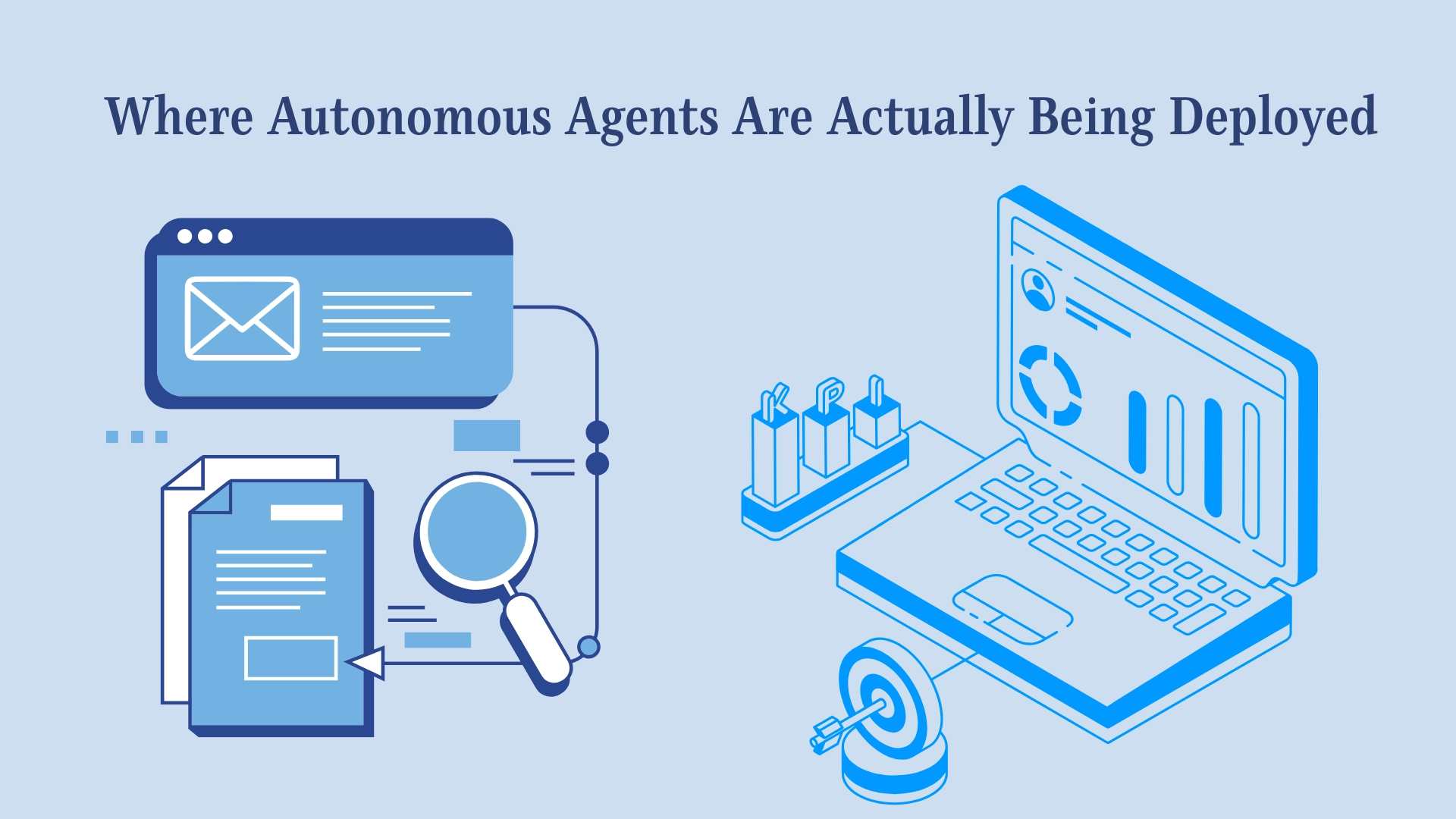
Agentic AI Use Cases: Where Autonomous Agents Are Actually Being Deployed in 2026
“Agentic AI” is easy to define in the abstract and hard to picture in practice. What does an autonomous agent actually do inside a real business — and where is it already running, as opposed to still being piloted? This piece works through the agentic AI use cases with the strongest evidence behind them: what the agent does, why traditional automation couldn’t do it, and where the data on adoption and ROI actually stands.
At CodeStore, we build agentic AI systems for clients evaluating exactly this question — which use case to start with, and how to structure a pilot that’s likely to scale. You can see our agentic AI development services or get in touch if you’re scoping a project.
What Separates an Agentic AI Use Case From Traditional Automation
Before the list, a distinction worth being precise about. According to Anthropic’s engineering guidance on building agents, most production systems today are “workflows” — an LLM and tools orchestrated through predefined code paths — while true agents dynamically direct their own process and tool use to accomplish an open-ended task. Anthropic’s own advice is to use the simplest pattern that solves the problem, not to default to full autonomy.
What qualifies a real agentic AI use case, as distinct from a rebadged script, is usually some combination of: the system perceives unstructured input (a ticket, an email, a sensor reading) rather than only structured fields; it reasons through more than one viable path rather than following a fixed branch; it acts across multiple tools or systems in sequence; and it can be evaluated and improved based on outcomes. A chatbot with a decision tree behind it isn’t an agentic AI use case just because it uses a language model — Gartner has warned about exactly this kind of “agent washing,” where existing RPA or chatbot tools get relabeled as agentic without the underlying capability changing.
The Adoption Picture, in Numbers
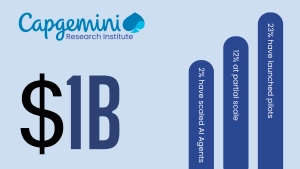
The most detailed data on where agentic AI use cases are actually landing comes from the Capgemini Research Institute’s 2025 survey of 1,500 executives at companies with over $1 billion in revenue. It found adoption is real but early: about 2% of organizations have deployed AI agents at scale, 12% at partial scale, 23% have launched pilots, and the rest are still exploring. Despite that early stage, 93% of business leaders believe scaling AI agents over the next 12 months will provide a durable competitive edge — a gap between ambition and maturity that shows up across most of the enterprise AI research right now.
The same Capgemini research is unusually specific about where organizations intend to use agents first: 94% have already deployed or intend to deploy AI agents for procurement and supply chain planning, 91% for customer support, 89% for financial planning and analysis, 84% for employee recruitment, and 74% for performance management. That ordering is a useful map for the use cases below — it roughly tracks which functions have the clearest agentic AI use cases available today.
Agentic AI Use Cases by Business Function
Customer Support and Service
This is the most mature category by volume of production deployments. Instead of a scripted decision tree, a support agent can read a full ticket or chat history, pull account and order data from multiple systems, reason about the appropriate resolution, and — critically — take the action itself, such as issuing a refund within a defined limit or rebooking a shipment, rather than only drafting a suggested response for a human. Gartner projects that by 2029, agentic AI will autonomously resolve 80% of common customer service issues without human involvement, alongside a meaningful reduction in operational cost.
Procurement and Supply Chain
The highest-intent use case in Capgemini’s data, and for a clear reason: procurement involves exactly the kind of multi-system, multi-variable reasoning that traditional rule-based automation struggles with — checking supplier reliability, current inventory, shipping lead times, and pricing simultaneously, then adjusting when any one of those changes. An agent monitoring live signals can rebalance orders or reroute shipments when a disruption hits, rather than waiting for a human to notice and intervene. The realistic impact still depends heavily on data quality and how much decision authority the system is given.
Financial Planning, Analysis, and Fraud Detection
In finance functions, agentic AI use cases split into two clusters: back-office analysis (consolidating data across systems, flagging variances, drafting forecasts for review) and real-time risk work like fraud detection and underwriting, where an agent can reason across multiple risk signals and evaluate a case against policy rather than applying one fixed rule. Because financial decisions are consequential, most production deployments here keep a human in the loop for anything above a defined risk or dollar threshold.
Software Development and IT Operations
Coding and DevOps agents are among the most mature agentic AI use cases in production, largely because their output is easy to verify automatically — tests either pass or they don’t. Common deployments include autonomous code review, CI/CD pipeline management, and IT service-desk agents that triage, diagnose, and resolve common incidents without a ticket ever reaching a human queue. This is also one of the functions McKinsey’s 2025 State of AI research found among the furthest along, with double-digit cost reductions reported by organizations that had scaled agentic AI in software engineering and IT specifically.
HR: Recruitment and Performance Management
Recruitment agents can screen resumes against a role’s actual requirements, schedule interviews across calendars, and draft personalized outreach — tasks that are high-volume and judgment-light enough to delegate, while final hiring decisions stay with people. Performance management is an earlier-stage use case: agents that synthesize feedback and flag patterns across a team, though this is an area where the consequences of getting it wrong (unfair or biased evaluation) argue for more oversight, not less.
Manufacturing and Predictive Maintenance
Production scheduling, changeover planning, and maintenance prediction are classic cases where fixed automation breaks down under real-world variability — a static schedule doesn’t know a machine is showing early signs of failure. Capgemini’s survey found manufacturing among the leading sectors for current AI agent use, at 28% of companies already using agents in some capacity, and this is one of the use cases McKinsey’s research also flags as further along than most.
Healthcare: Clinical Documentation and Scheduling
Clinical documentation agents that draft notes from a patient encounter, and scheduling agents that manage the many constraints of clinic capacity, are active areas of deployment. Regulatory and safety requirements mean autonomy levels here are typically kept lower than in other functions — an agent drafting a note for a clinician to review is a very different risk profile from one making a treatment recommendation independently.
Sales and Marketing
Agentic AI use cases here include lead qualification (reasoning about which prospects match ideal-customer criteria rather than applying a fixed scoring rule), and campaign agents that can run continuous experimentation across channels instead of one-off launches. This is a lower-risk category for autonomy in the sense that mistakes are usually correctable rather than consequential, which is part of why marketing and sales are among the functions organizations are prioritizing for near-term AI investment.
Where the Evidence Says Adoption Is Furthest Along
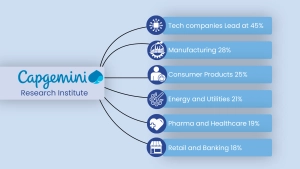
Capgemini’s sector-by-sector data gives a clearer adoption ranking than most vendor content offers: high-tech companies lead at 45% already using AI agents in some capacity, followed by manufacturing (28%), consumer products (25%), energy and utilities (21%), pharmaceuticals and healthcare (19%), and retail and banking (both 18%). Insurance, automotive, aerospace, and telecommunications trail behind. That spread roughly tracks which industries have the cleanest data infrastructure and the most repetitive-but-variable workflows — the two conditions that make an agentic AI use case viable in the first place.
The Business Case, With Real Caveats
The case for agentic AI use cases is strongest where a task is high-volume, has meaningful variability, and produces output that’s checkable — either automatically (tests, compliance rules) or through a fast human review. McKinsey’s research found the functions furthest along, like software engineering and IT, reporting 10–20% cost reductions among organizations that had actually scaled agentic AI — but overall enterprise-wide financial impact remains concentrated among a smaller group of high performers, and plenty of organizations report AI use without it yet moving their results.
That gap between activity and impact is worth taking seriously before picking a use case. Gartner has projected that more than 40% of agentic AI projects will be canceled by the end of 2027, citing escalating costs, unclear business value, and inadequate risk controls — a reminder that “there’s a use case for this” is necessary but not sufficient; the use case still has to be scoped, integrated, and governed well to actually deliver.
Governance Across Every Use Case
Every use case above sits at a different point on the autonomy spectrum, and that’s deliberate. NIST’s AI Risk Management Framework — built around four functions (Govern, Map, Measure, Manage) — is a useful baseline for deciding how much autonomy a given use case should actually get. The consistent pattern across mature deployments is that autonomy scales with how correctable a mistake is. A marketing agent that sends a bad email is cheap to fix. A finance agent that approves a fraudulent transaction, or a healthcare agent that documents a clinical encounter incorrectly, is not — which is why those use cases keep a human in the loop even where the underlying technology could, in principle, act independently.
Picking Your First Use Case
A few criteria that separate agentic AI use cases likely to succeed from ones likely to stall:
- High volume, meaningful variability. If a task happens rarely, the ROI on building an agent for it is thin. If it never varies, traditional automation is cheaper.
- Verifiable output. Use cases where a human or system can quickly check whether the agent got it right — passing a test, matching a policy rule — scale faster than ones requiring subjective judgment on every output.
- Correctable mistakes, at least at first. Start with a use case where an error is inconvenient rather than dangerous, and expand autonomy as the system proves itself.
- Clean, accessible data. Every use case above depends on the agent being able to actually reach the data it needs across systems — this is a more common blocker than model capability.
- A defined owner for governance. Someone accountable for what the agent is and isn’t allowed to do, before the pilot launches, not after.
At CodeStore, this is the evaluation we walk clients through before recommending a specific agentic AI use case to pilot — matching the criteria above against a client’s actual data, systems, and risk tolerance. Contact us if you’re weighing which use case to start with.
Frequently Asked Questions
The Bottom Line
The agentic AI use cases with the strongest evidence behind them share a pattern: high transaction volume, meaningful variability, and a way to verify whether the agent got it right. Customer support, procurement, financial analysis, software development, and recruitment lead current deployment, and the industries furthest along — high-tech, manufacturing, and consumer products — tend to have the cleanest data foundations to support them.
None of this means every use case is ready for full autonomy today. The organizations getting real value are the ones matching the level of autonomy to how correctable a mistake is, and treating governance as part of the design rather than an afterthought.
Want to work through which agentic AI use case fits your operations first? Contact us or explore our agentic AI development services.