
table of content
- Agentic AI vs Generative AI
- What’s the Real Difference
- What Is Generative AI in Real
- What Is Agentic AI in Real
- The Core Difference
- Why US Enterprises Are Paying Attention Right Now
- Where Each One Actually Delivers Value
- Where They Work Best Together
- The Risk Side Nobody Talks About Enough
- Which One Should You Adopt First?
- Frequently Asked Questions
- The Bottom Line


Agentic AI vs Generative AI: Key Differences Enterprises Must Know
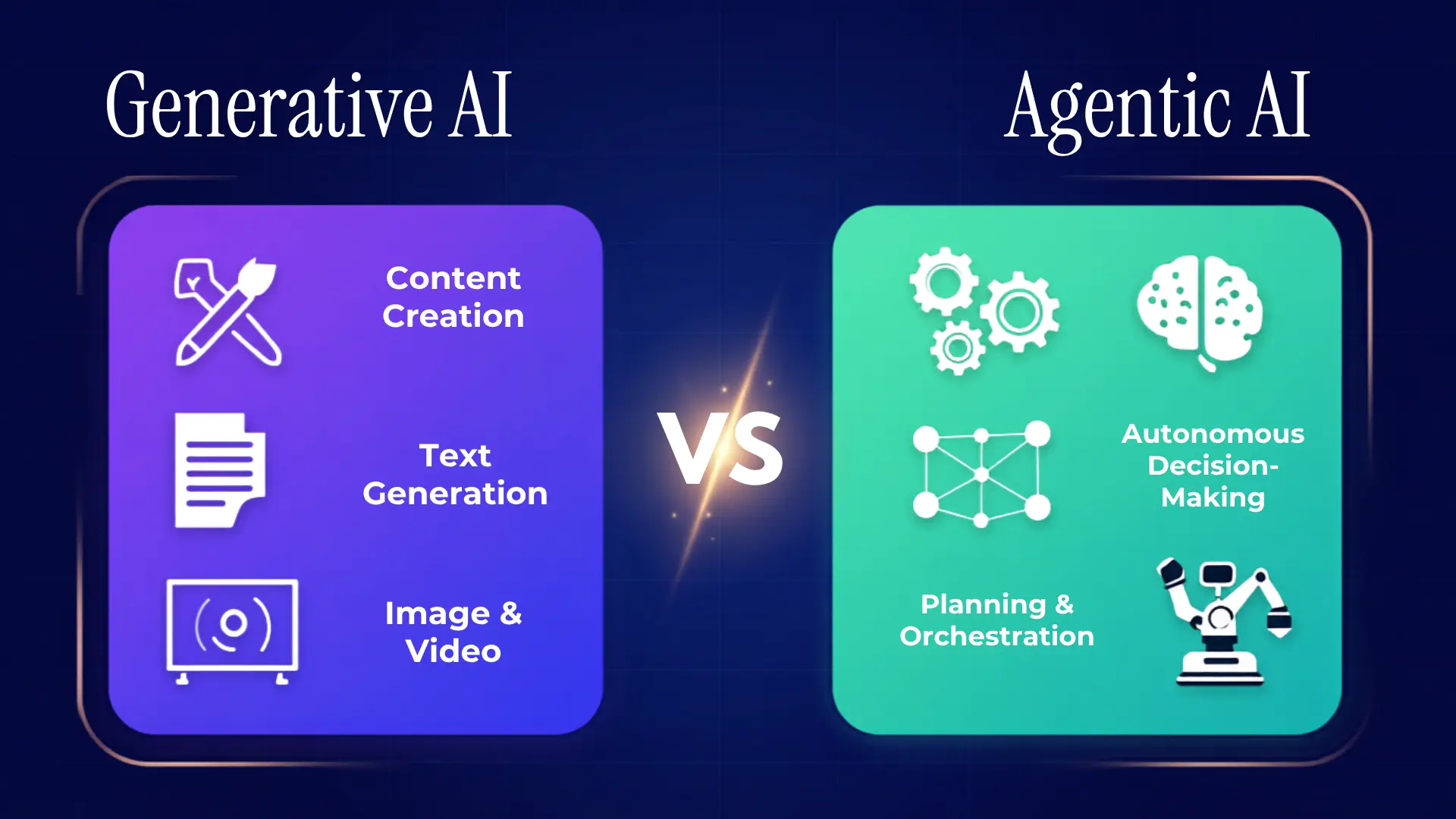
Agentic AI vs Generative AI: What’s the Real Difference
If you’ve spent any time on LinkedIn lately, you’ve probably noticed everyone suddenly has an opinion on agentic AI vs generative AI. Half the internet is calling agentic AI “the next ChatGPT moment.” The other half thinks it’s just generative AI with a fancier name. Neither is quite right.
Here’s the honest, no-fluff version: generative AI and agentic AI are not competitors, and they’re not the same thing either. They solve two completely different problems. One creates. The other executes. And if you’re a US-based enterprise trying to figure out where to put your AI budget in 2026, understanding that difference isn’t optional — it’s the decision that determines whether your AI investment turns into real ROI or just another expensive pilot program that quietly dies in Q3.
Let’s break this down properly.
What Is Generative AI in Real ?
Generative AI is the category most people already know, even if they don’t call it that. It’s the technology behind tools that take a prompt and produce something new — text, images, code, video, you name it. Instead of pulling up an existing answer from a database, generative AI models learn patterns from massive datasets and use them to generate original output.
Think of it as an incredibly fast, incredibly well-read assistant who’s great at first drafts. You give it context — your brand voice, a customer segment, a product spec — and it hands back a blog post, an ad variant, a product description, or a chunk of code. It’s reactive. It waits for your prompt, does its job, and stops.
For content teams, marketing departments, and product teams across the US, this has already reshaped how fast work gets done. Campaign timelines that used to take weeks now take days. Personalized content that would’ve needed a dozen writers now gets drafted in minutes. That’s the generative AI value proposition in a sentence: it accelerates creation.

What Is Agentic AI in Real ?
Agentic AI is where things get more interesting — and more misunderstood. An AI agent doesn’t just respond to a single prompt and stop. It’s built to pursue a goal, break that goal into steps, make decisions along the way, use external tools or APIs, and keep going until the task is actually done — with a human checking in at key decision points rather than approving every single micro-step.
The simplest way to explain agentic AI to a non-technical stakeholder: it’s the difference between an assistant who drafts an email for you to review, and an assistant who drafts it, sends it at the right time, watches how the recipient responds, and adjusts the follow-up based on that response — all without you touching a keyboard.
Under the hood, this is powered by frameworks like LangChain, LangGraph, CrewAI, and AutoGen, orchestrating multiple specialized agents that hand off tasks to each other. Add memory, tool access, and a feedback loop, and you get something that behaves less like software and more like a junior employee who never sleeps.
This is also exactly the kind of system architecture our team builds through CodeStore’s agentic AI development services — designing multi-agent workflows that plug into a company’s existing CRMs, databases, and internal tools, with human-in-the-loop checkpoints built in so nothing autonomous goes rogue.
Agentic AI vs Generative AI: The Core Difference in One Table
Neither one replaces the other. Generative AI is the engine that produces the raw material. Agentic AI is the system that decides what to do with it, when, and for whom.
Why US Enterprises Are Paying Attention Right Now
Enterprise adoption of generative AI in the US has moved well past the pilot stage — it’s now embedded across marketing, sales, support, and operations at a scale that would’ve seemed unrealistic just two years ago. And agentic AI is following the exact same trajectory, just a step behind. Analysts tracking the AI agent market expect it to grow at a steep annual clip over the next few years as more Fortune-caliber companies move from “let’s experiment with an agent” to “let’s put an agent in front of real customers.”
That timing matters. Businesses that treat agentic AI as a 2027 problem are going to spend the next twelve months watching competitors automate lead routing, customer onboarding, and internal reporting while they’re still manually copy-pasting generative AI outputs into spreadsheets.
Where Each One Actually Delivers Value
Generative AI shines at:
- Drafting marketing copy, blogs, and social content at speed
- Producing on-brand creative variations for different audiences
- Summarizing dense data, research, or reports into plain language
- Powering first-draft code generation for developers
Agentic AI shines at:
- Running end-to-end customer journeys without manual hand-offs
- Qualifying and routing leads based on real-time behavior
- Monitoring live campaigns or systems and adjusting automatically
- Coordinating multiple tools (CRM, calendar, ticketing, database) to complete a task fully, not just partially

Where They Work Best Together
The businesses getting the most out of AI right now aren’t choosing one over the other — they’re pairing them. Generative AI drafts the campaign brief, the email sequence, the chatbot response. Agentic AI decides who receives what, when, and adjusts the approach in real time based on how people actually respond.
A practical example: a SaaS company preparing a renewal campaign might use an AI agent to identify which accounts are at risk of churning and figure out the right discount tier for each, while generative AI simultaneously drafts the tailored email copy for every one of those segments. Neither piece works as well alone. Together, they compress a process that used to take a full marketing sprint into a single afternoon.
The Risk Side Nobody Talks About Enough
This is the part that gets skipped in most “agentic AI vs generative AI” explainers, and it’s the part that actually matters for enterprise decision-makers.
Generative AI carries risks around accuracy (confident-sounding but wrong outputs), IP exposure, and bias baked into training data. These are manageable with human review, fact-checking layers, and clear approval workflows.
Agentic AI’s risks are a different animal entirely, because autonomy means mistakes can compound before anyone notices. An agent with the wrong permissions can trigger the wrong email to the wrong list, or access data it shouldn’t. Multi-agent chains can be hard to trace — if something goes wrong, figuring out which agent made which decision isn’t always straightforward.
The fix isn’t avoiding agentic AI. It’s building it correctly from day one: human-in-the-loop checkpoints at meaningful decision points, centralized permissions across every connected tool, sandboxed testing before anything touches production, and full logging so every agent decision is traceable and explainable. This is precisely why “agentic AI development services” as a category exists — most companies don’t have in-house teams who’ve built and secured multi-agent systems before, and getting the guardrails wrong the first time is expensive.

Which One Should You Adopt First?
If your organization is still early in its AI journey, start with generative AI. It’s lower-risk, faster to show ROI, and builds the internal comfort and governance muscle you’ll need before layering on autonomous decision-making. Once your team trusts the outputs, has clean data pipelines, and has a governance framework in place, that’s the right moment to bring in agentic AI for orchestration and execution.
Trying to jump straight to a fully autonomous multi-agent system without that foundation is how “AI pilot” turns into “AI horror story” — and it’s the single most common mistake we see enterprises make when they treat agentic AI as a plug-and-play upgrade rather than an architecture decision.
Frequently Asked Questions
The Bottom Line
Generative AI gave businesses a faster way to create. Agentic AI is giving them a faster way to execute. Confusing the two — or assuming one replaces the other — is how AI budgets get wasted on the wrong tool for the job.
If you’re a US enterprise trying to figure out where agentic AI fits into your existing stack, that’s a conversation worth having with a team that’s actually built these systems before, not just read about them. That’s exactly the kind of architecture-first work we do through our agentic AI development services — from initial audit to secure, human-in-the-loop deployment.