
table of content
- Is Agentic AI the Future of Automation?
- The Ceiling on Traditional Automation
- What Actually Makes an AI Agent Different
- Where Autonomous Agents Are Already in Production
- Why the Business Case Is Getting Harder to Ignore
- Safety, Autonomy, and Governance
- Common Misconceptions, Corrected
- Industries Where Adoption Is Furthest Along
- Planning a Transition, Realistically
- Frequently Asked Questions
- The Bottom Line


Is Agentic AI the Future of Automation?

Is Agentic AI the Future of Automation? What the Data Actually Shows
Traditional automation has run the back office and the factory floor for decades — scripted workflows, fixed rules, predictable output. Something is now shifting alongside it. Autonomous AI agents, built on large language models, are starting to handle work that rule-based systems were never designed for: judgment calls, shifting conditions, and multi-step tasks that don’t follow a script.
This piece looks at what agentic AI systems actually do differently from RPA and rule-based automation, where the evidence for adoption stands today, where the hype outruns the data, and how to think about a pilot if you’re evaluating the shift. At CodeStore, we’ve worked with organizations moving from rule-based automation toward agent-based systems across customer service, supply chain, and internal operations — you can see our agentic AI development services or get in touch if you’re scoping a project.
The Ceiling on Traditional Automation
Traditional automation is built for repetition: robotic assembly lines, rule-based software workflows, scripted IVR trees. When a task is truly stable and repeatable, these systems are hard to beat — cheap to run, predictable, and fast.
The trouble starts when conditions stop holding still. Customer questions deviate from the script. A supplier misses a shipment. Demand spikes outside the range the rules were written for. Traditional automation doesn’t adapt to that — it fails, escalates to a human, or simply produces the wrong output, because it was never built to reason about a situation it wasn’t explicitly programmed for.
That gap — between rigid, rule-based execution and the variability of real operations — is the opening that intelligent automation and agent-based systems are built to address.
What Actually Makes an AI Agent Different
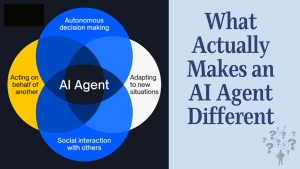
“Agentic AI” gets used loosely, so it’s worth being precise. According to Anthropic’s engineering guidance on building agents, the term covers a spectrum: some systems follow predefined workflows where an LLM and tools are orchestrated through fixed code paths, while others are genuine agents that dynamically direct their own process and tool use to accomplish a task. Anthropic’s own recommendation is to start with the simplest pattern that solves the problem and add agentic autonomy only when the task genuinely needs it — not to reach for a fully autonomous agent by default.
The practical building blocks are consistent across implementations: an environment the agent operates in, a set of tools it can call, and a system prompt that defines its goals and constraints. Layered on top of a capable model, that combination lets a system do a few things rule-based automation structurally cannot:
- Perceive unstructured context — text, tickets, logs, sensor data — rather than only fields it was explicitly programmed to read
- Reason through multiple options and tradeoffs instead of following one fixed branch
- Act across several steps and tools in sequence, adjusting as new information comes in
- Improve based on feedback loops, when a system is deliberately designed with evaluation built in
None of this makes agentic systems infallible or self-improving by default — that depends heavily on architecture, data quality, and how much autonomy a team is willing to grant. But it’s a structurally different approach to automation than a fixed decision tree.
Where Autonomous Agents Are Already in Production
The clearest current evidence comes from large-scale enterprise surveys rather than isolated case studies. McKinsey’s 2025 State of AI report, based on responses from nearly 2,000 organizations, found that 88% of companies now use AI in at least one business function, and 23% report they are actively scaling agentic AI in at least one function — with IT, knowledge management, and engineering leading adoption. That same research found high-performing organizations were far more likely to have redesigned workflows around AI rather than layering it on top of existing processes, and reported double-digit cost reductions in software engineering and IT specifically.
Gartner has also predicted that [40% of enterprise applications will feature task-specific AI agents by 2026], up from less than 5% in 2025, highlighting how quickly agent capabilities are expected to become embedded in enterprise software.
A few areas where adoption is furthest along:
Customer service. Gartner projects that by 2029, agentic AI will autonomously resolve 80% of common customer service issues without human involvement, alongside a meaningful reduction in operational cost. The shift Gartner describes isn’t just faster scripted responses — it’s agents that can take action on a customer’s behalf, such as navigating a cancellation flow or negotiating a shipping rate, rather than only answering questions.
Supply chain and logistics. Rule-based inventory systems struggle once disruptions — weather, supplier delays, demand surges — push conditions outside their programmed thresholds. Agent-based systems that can monitor live signals, weigh alternatives, and adjust routing or reordering dynamically are a natural fit here; the realistic impact depends heavily on data quality and how much decision authority the system is given, not just on deploying the technology.
Manufacturing. Scheduling, changeovers, and predictive maintenance are classic cases where fixed automation breaks down under real-world variability. Agent-based scheduling that reasons about current equipment status and demand, rather than following a static sequence, is one of the more mature agentic use cases in the McKinsey manufacturing cohort.
Quality monitoring. Sampling-based inspection misses variation between samples. Continuous, agent-driven monitoring can, in principle, catch anomalies as they occur rather than after the fact — though this requires substantially more sensor and data infrastructure than periodic sampling.
Why the Business Case Is Getting Harder to Ignore — With Caveats

The economics favor agentic approaches for variable, complex work, though the numbers are more nuanced than the adoption headlines suggest. McKinsey’s research points to double-digit cost reductions in the functions furthest along — software engineering and IT saw 10–20% cost reductions among scaling organizations — while overall enterprise-wide financial impact remains concentrated in a smaller group of high performers; many organizations report AI use without yet seeing it show up in their bottom line.
Deployment speed is a genuine advantage in the right cases: once an agent is set up for a class of problem, it can often handle new variations without the reprogramming a rule-based system would need. But “faster” isn’t universal — agentic implementations still require real integration work, evaluation, and guardrail design, and that work takes time regardless of the underlying model.
Where traditional automation and agent-based systems tend to differ most is in how each handles a growing number of edge cases. A rule-based system generally needs new rules for each new variation; an agent-based system can often generalize across variations it wasn’t explicitly programmed for. That’s a real structural advantage — but it’s not a guarantee of lower cost or faster ROI in every deployment.
Safety, Autonomy, and Governance
None of this works responsibly without governance, and this is where a lot of early agentic AI projects run into trouble. The National Institute of Standards and Technology’s AI Risk Management Framework — voluntary guidance built around four functions (Govern, Map, Measure, Manage) — has become a widely referenced baseline for organizations trying to manage the risks that come with giving a system more autonomy, including questions about when human approval should be required before an agent takes a consequential action.
The practical takeaway for a business evaluating agent-based systems: autonomy is a dial, not a switch. The right level of human oversight depends on how consequential the agent’s actions are — an agent that drafts a customer response for review is a very different risk profile from one that can independently issue a refund or change a production schedule. Treat governance as part of the design from the start, not something bolted on after a pilot succeeds.
Common Misconceptions, Corrected
“Agentic AI replaces all traditional automation.” In practice, the two coexist. Simple, truly repetitive tasks are often still cheaper and more reliable on rule-based automation. Agent-based systems earn their cost where variability and judgment are the bottleneck, not everywhere.
“Adoption is universal and low-risk at this point.” It isn’t. Gartner has projected that more than 40% of agentic AI projects will be canceled by the end of 2027, citing escalating costs, unclear business value, and inadequate risk controls — and has separately warned about “agent washing,” where existing chatbots or RPA tools get rebranded as agentic without the underlying capability. Enthusiasm for the category shouldn’t be mistaken for a guarantee that any given implementation will work.
“It’s too expensive to justify.” Upfront implementation costs are often comparable to traditional automation; the differentiation tends to show up in operating costs over time, and mainly for organizations that redesign the workflow around the agent rather than dropping one into an unchanged process.
“It replaces the workforce.” The available data doesn’t support a clean replacement narrative. Most reporting on scaled deployments describes agents absorbing defined categories of routine work while people handle judgment calls, escalation, and oversight — the composition of roles shifts more than headcount collapses outright.
Industries Where Adoption Is Furthest Along
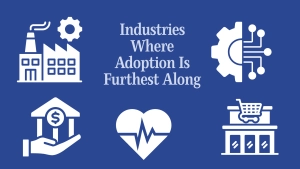
Manufacturing — production scheduling, quality monitoring, and maintenance prediction are the most cited use cases among scaling organizations in McKinsey’s research.
Financial services — fraud detection and risk workflows benefit from an agent’s ability to weigh multiple signals rather than apply a fixed rule.
Healthcare — clinical scheduling, documentation support, and resource allocation are active areas of experimentation, though regulatory and safety requirements mean autonomy levels here are typically kept low.
Retail — dynamic pricing and inventory decisions are a natural match for systems that need to respond to changing demand rather than fixed thresholds.
Technology — infrastructure monitoring and developer-workflow agents (such as coding agents) are among the more mature production deployments, in part because their output — passing tests, resolving a ticket — is easy to verify automatically.
Planning a Transition, Realistically
If you’re evaluating whether an agent-based approach makes sense, a few steps make the difference between a pilot that scales and one that stalls:
- Audit where rule-based automation is actually struggling. Complex decisions, frequent rule changes, and high exception rates are the strongest candidates — not just “AI would be nice here.”
- Check your data foundation before your model choice. Agent performance is bottlenecked by data quality and access more often than by the underlying model.
- Pilot one high-impact problem, with a human in the loop. Three to six months is a reasonable window to judge whether an agent-based approach is actually outperforming the status quo.
- Build the governance alongside the pilot, not after it — define what level of autonomy the agent has and where a human sign-off is required.
- Plan for coexistence, not wholesale replacement. Agent-based systems will run alongside your existing rule-based automation for a long transition period, not instead of it from day one.
At CodeStore, this is the shape of the work we do with clients moving from rule-based automation toward agentic AI systems — auditing existing automation, scoping a pilot, and building in the governance from the outset. Contact us if you want to talk through where this fits for your operations.
Frequently Asked Questions
The Bottom Line
Is agentic AI the future of automation? The evidence supports a qualified yes: adoption is real and accelerating, and the functions further along report measurable gains. It’s not a wholesale replacement for traditional automation, and a meaningful share of current projects will fail to reach production for the same reasons most technology initiatives fail — unclear scope, weak data foundations, and governance added too late.
Traditional automation keeps its place for genuinely repetitive, stable work. For the complex, variable work that makes up most of modern operations, agent-based systems are increasingly the more capable option — provided the rollout is scoped honestly and governed from the start.
Want to work through whether an agentic AI pilot makes sense for your operations? Contact us to talk through the specifics, or take a look at our agentic AI development services.