
table of content
- How AI Is Changing Mobile App Development in 2026
- Practical Uses of AI in Mobile Application Development
- The Development Workflow and AI
- Personalization, UX, and What Can Go Wrong
- Technical Trade-offs That Product Teams Should Consider
- What AI in a Mobile App Actually Costs?
- When AI Makes Sense and When It Doesn’t?
- What Companies Should Consider Before Developing an AI-Powered App
- Where Will Things Go from Here?
- Conclusion
- FAQs


How AI Is Changing Mobile App Development in 2026
AI Trends, Use Cases & Development Insights for Mobile Apps in 2026
Superficial similarities in mobile apps built in 2023 and those built in 2026 may be apparent; however, differences in app functionality, such as recommendation systems, content generation, and chat functionality, may exist.
The significance of AI in mobile app development is increasing. As with any other app feature, companies must make a business case to justify the cost of integrating AI into an app. The additional cost of integrating AI may include the cost of constructing and maintaining computing infrastructure to support AI and the cost of integrating AI to improve the overall product experience.
However, there may be instances where integrating AI into an app may improve the product. It may be prudent to evaluate the potential gain AI may have on a product to help address the overall product experience.
The purpose of this article is to address potential changes in AI mobile app development and evaluate potential scenarios that may justify the use of AI in mobile applications.
At the same time these issues affect all systems and require a range of design decisions that must be made by developers. How will the system determine which data to use? Where will processing take place? How will the system validate the response? What will the system do if the AI generates an incorrect or invalid response?
This is different from the traditional software development process and may take the development team in unanticipated or undocumented directions.
Practical Uses of AI in Mobile Application Development
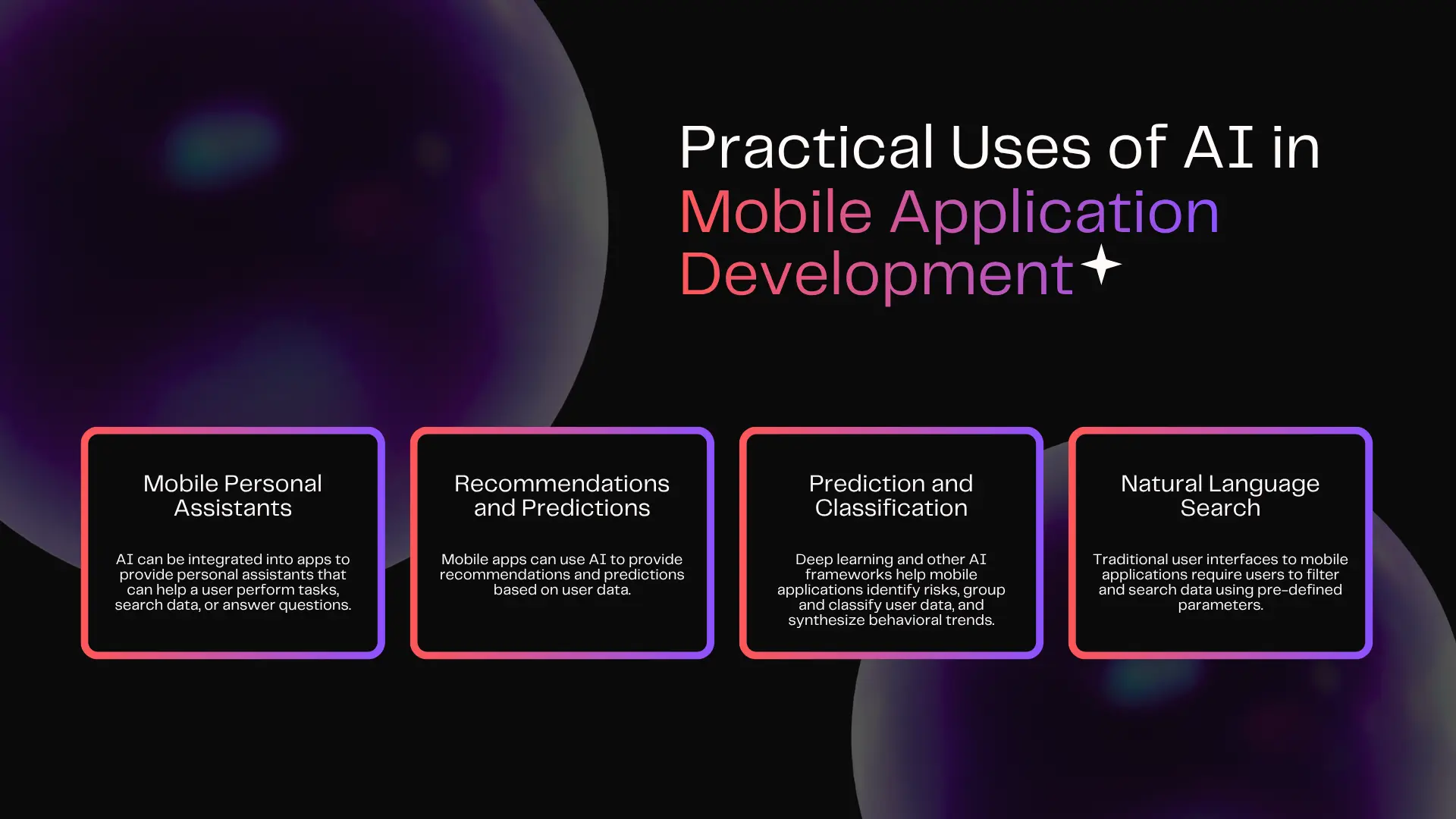
Mobile Personal Assistants
AI can be integrated into apps to provide personal assistants that can help a user perform tasks, search data, or answer questions.
Typically, virtual assistants are integrated into apps to replace long or convoluted interfaces. For example, a virtual assistant integrated into a banking app could allow a user to perform tasks such as transferring money. However, virtual assistants raise a variety of privacy and security concerns that must be documented and designed into the app.
Sibot is an example of integrating a personal assistant into a mobile app. The Sibot case study provides additional context for this type of implementation.
For teams evaluating similar functionality, the guide on adding AI features to an existing application provides additional implementation context.
Recommendations and Predictions
Mobile apps can use AI to provide recommendations and predictions based on user data.
Making recommendations based on user data allows applications to personalize their suggestions. Unlike recommendations generated through a basic rules-based process, personalization can increase the chance that the user will find the recommendation relevant and useful. This is one of the practical applications of AI-powered mobile apps.
However, there are a number of considerations when creating a recommendation system. It is important to evaluate the data being collected, the amount of data available, and whether the recommendation system can ensure relevance with limited or changed user data.
Prediction and Classification
Deep learning and other AI frameworks help mobile applications identify risks, group and classify user data, and synthesize behavioral trends.
AI can be used in education to analyze student data, inform and structure educational content, and assess student and teacher performance.
An AI-powered EdTech implementation provides another example of this type of application. The EdTech case study can provide additional project context for teams evaluating how AI may be incorporated into an education-focused platform.
These frameworks allow product teams to provide recommendations and generate predictions. However, building and incorporating AI to develop or alter those recommendations and predictions introduces additional considerations.
Natural Language Search
Traditional user interfaces to mobile applications require users to filter and search data using pre-defined parameters. Mobile applications can leverage AI to allow users to search and filter data using natural language.
In addition, AI can be used to synthesize and create text, but product teams should maintain control over the content and recommend appropriate remediation for inaccurate content.
These capabilities are part of the broader AI in app development landscape, where natural-language interaction can be added to existing application workflows without replacing the complete application interface.
The Development Workflow and AI
The development of AI technologies changes the way development teams work.
Traditionally, features of apps are developed by breaking them down into smaller components. Each of these components is defined by determining the required inputs and outputs.
However, features enabled by AI rely on several other factors, such as the quality of input data. AI may also respond to queries with a certain level of confidence. In such a case, the development team may have to define a threshold to determine whether an answer should be considered valid.
The development team has to define edge cases, explain how the system should respond when the input data is ambiguous, and consider how the system should behave when an external model is unavailable.
Along with traditional software testing, to validate that a desired output is generated, a development team may have to consider various input permutations and combinations. Latency of the system should also be considered.
For broader application quality, Software Testing and QA can be included as part of the testing process for AI-enabled applications.
Once the system is released, a development team may have to continuously monitor the system to account for these use cases.
This workflow is one of the important AI trends in mobile app development, because AI features require teams to consider not only whether a feature works but also how it behaves when inputs, outputs, data, or external services change.
Personalization, UX, and What Can Go Wrong
AI can enhance UX by presenting information that a user may find useful. Recommendations can also be distracting.
We expect conversational interfaces to engage users in a conversation. If an interface lacks the ability to adequately engage in a conversation and can only offer discrete interactions, it should not be confused with a conversational interface. Interfaces that offer only a fraction of the interactions required to provide a complete user experience create a negative user experience and will quickly gain a poor reputation. Support teams will be inundated with tickets about incorrect interactions.
For this reason, prior to building AI features, teams should determine boundary conditions. Features should not attempt to handle all interactions and should defer or pass control to the user if they are unable to determine the user’s intent.
AI features should amplify user interactions and help eliminate friction from user experiences.
Technical Trade-offs That Product Teams Should Consider
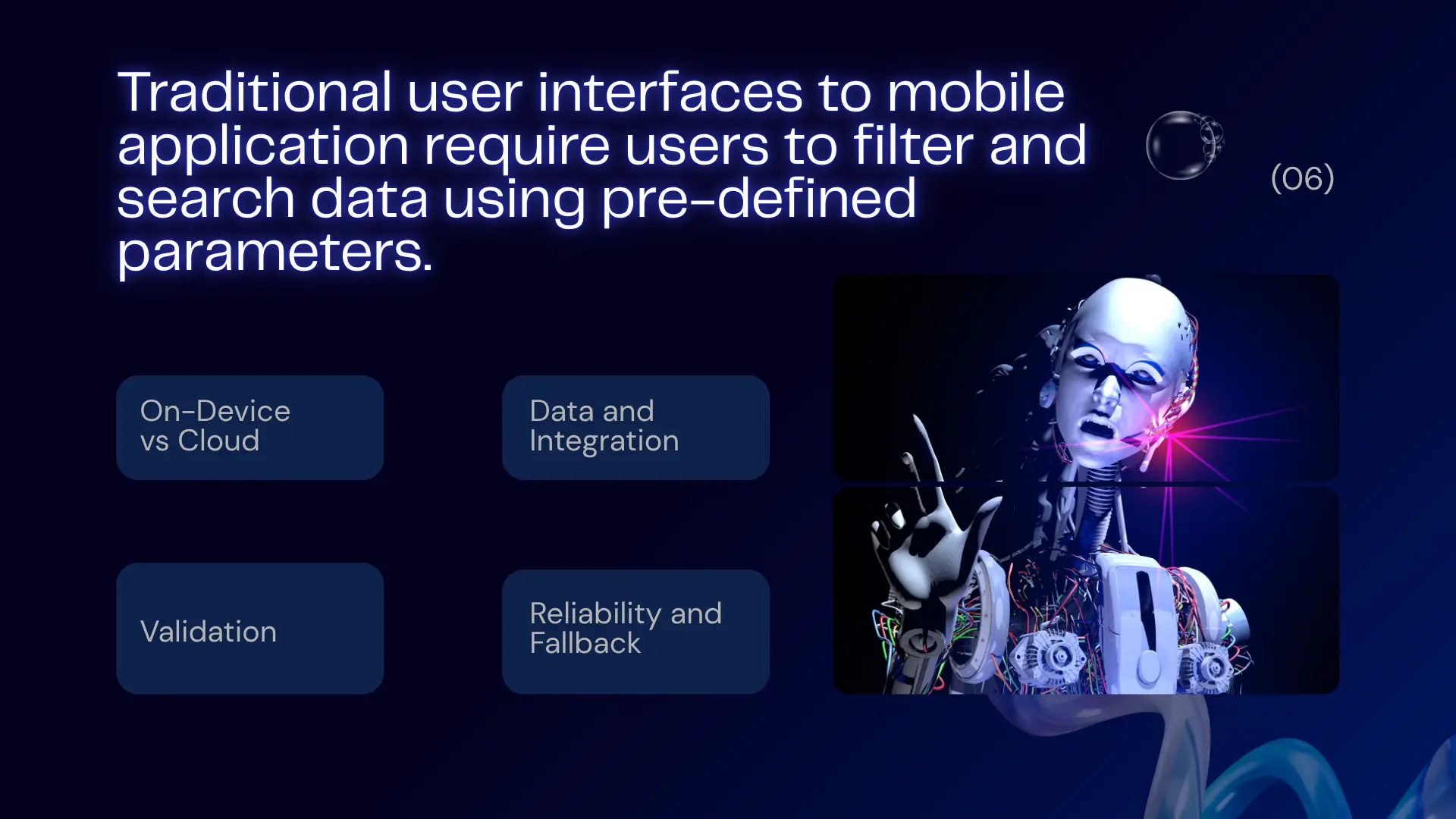
On-Device vs Cloud
Some AI models are large and complex, requiring cloud and/or external infrastructure. Other models are smaller and can be processed on a mobile device. For this reason privacy and latency concerns can affect how a model is deployed.
Apple’s Core ML documentation provides technical guidelines for on-device machine learning.
The choice between on-device and cloud processing is an important consideration when evaluating artificial intelligence in mobile app development, particularly when privacy, latency, device capability, and connectivity requirements differ between applications.
Data and Integration
Incorporating AI features impacts the overall architecture of a system and can touch almost every service, including the backend, user-facing app, AI model or API, database, authentication, and logs.
At the same time, AI features can offer potential value but increase the attack surface and require additional trust levels.
When an AI feature relies on external services, they should be considered as part of the overall feature integration. Third-party API integration can therefore become part of the wider architecture when an application depends on external AI services.
Validation
AI features should help process user input, but not all user input should be trusted. AI features should not be considered the final layer of control in a system. AI features should not be used as the sole mechanism for validating user input.
Depending on the scenario, response validation can verify the structure and format of response data. Response data can also be restricted to allow only specific, predefined values. Business logic can be implemented to validate responses.
Responses can be checked to ensure the requested information is accurate, and responses can be verified to prompt users for additional confirmation to ensure the correctness of the action to be taken.
To illustrate, if an AI system is creating a recommendation, the application can validate whether the recommended action is allowed for that user.
Reliability and Fallback
Because of the uncertainty in the AI system, the application must define a reliable fallback case.
One example of a reliable fallback case is using a traditional search function, displaying an error message, or taking a manual workflow.
AI features can increase the application’s exposure to sensitive information leaks and other security risks. AI features can also increase the attack surface area for the application.
Although there are many positive and negative implications of using AI, organizations need to consider their own security, privacy, compliance, and operational requirements before deploying AI features.
To better understand and implement a comprehensive risk management approach to the use of AI within an organization, the NIST AI Risk Management Framework can be helpful.
For many organizations, the main goal is to assess and adjust their AI features to production standards.
What AI in a Mobile App Actually Costs?
The cost of adding AI features to a mobile app can vary based on the expected functionality of the app.
Developing a system using prebuilt APIs may cost less upfront than creating custom models and data pipelines and building out the supporting AI infrastructure. However, the total cost of ownership also includes the cost of APIs and models, cloud infrastructure, data processing and storage, and other operating costs.
Expect substantial variability in total costs. A feature that is profitable with a low user base may become unprofitable with an increased user base and require refactoring.
Before development, determine expected request and data volumes and the type of responses. Assess dependence on third-party services and determine the type and level of monitoring required.
A proof of concept may help define the operating behavior and feasibility of the feature.
These considerations are central to AI app development, because the initial development cost does not necessarily represent the long-term cost of operating an AI-enabled feature.
When AI Makes Sense and When It Doesn’t?
AI has a positive impact on business when used to build features that would otherwise be difficult or expensive to build.
Intelligent features can improve the user experience with respect to personalization, interactivity, and automation. Predictive and descriptive features also lend themselves well to AI.
Similarly, using AI to automate features may also be appropriate. However, teams should consider the cost and benefits of using AI for features that introduce little to no improvement to a workflow.
AI is unlikely to improve workflows that are already logical and deterministic.
The correct question to ask is:
What product problems need solving with AI?
This question is particularly relevant when evaluating mobile app development trends 2026, because the availability of AI does not mean every application requires an AI-based solution.
What Companies Should Consider Before Developing an AI-Powered App
There are a few things companies should be considering before developing an AI-powered app.
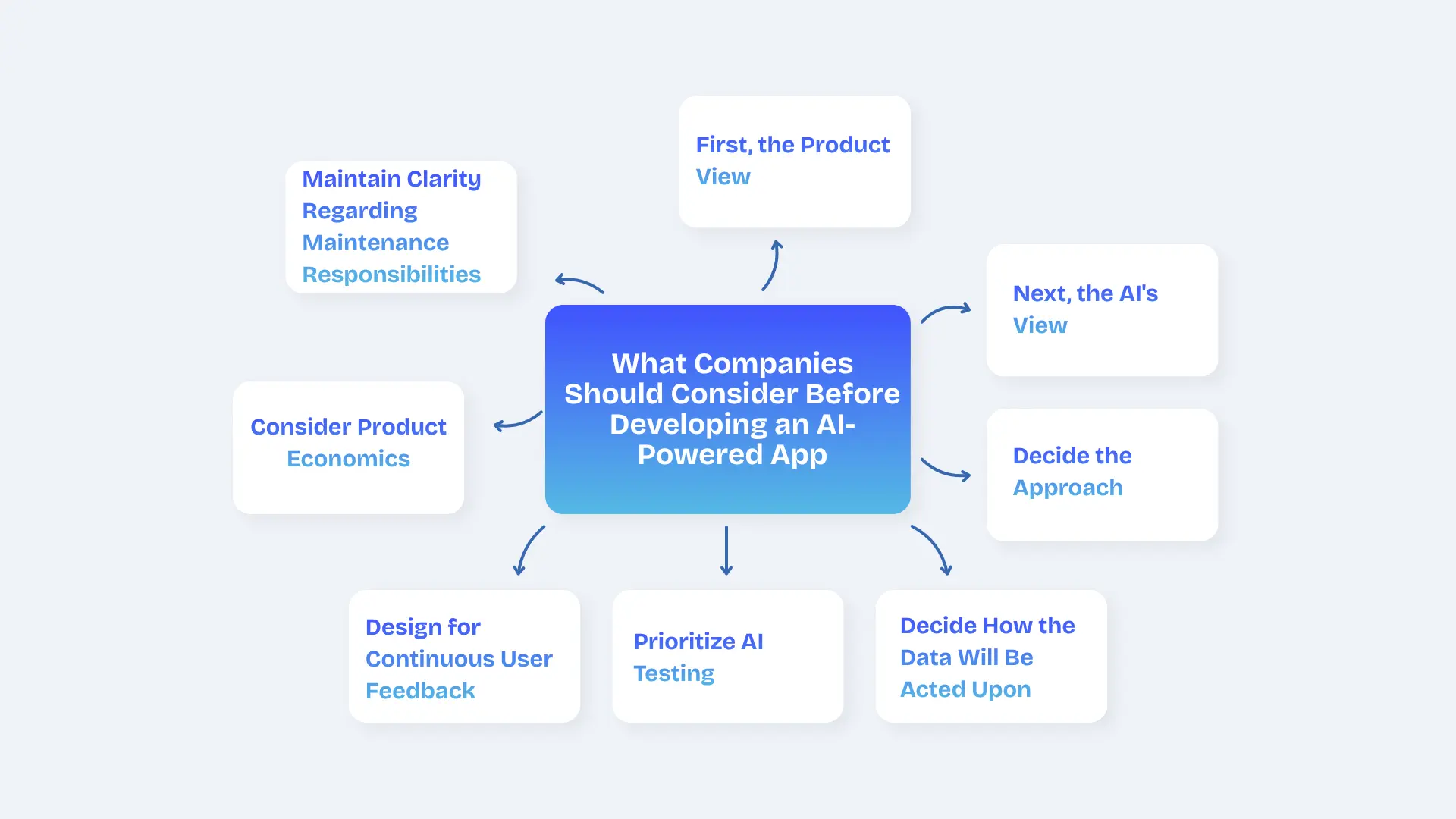
First, the Product View
Start by determining what the user or business problem is. Often, figuring out the user or business problem will signal to the team when AI is needed and serve as a clear goal for the team to work toward.
Next, the AI’s View
Determine the data that will be used to train or support the AI system. Evaluate the quality of the data and determine if the AI will be permitted to act on the data.
Decide the Approach
Depending on factors such as the device’s capability, the feature’s complexity, privacy, and latency, decide if the AI will process the data on the device, in the cloud, or both.
Decide How the Data Will Be Acted Upon
Determine fallback behavior and decide which actions the application will take if AI outputs do not fall within expected bounds. Also determine how the user interface should respond when AI output falls outside expected bounds.
Prioritize AI Testing
Design and develop the app to support AI testing. Determine the types of inputs that will be entered by end users and test for output quality.
Design for Continuous User Feedback
AI features may behave differently as user behavior, data, models, and external services change. Continuous user feedback can help development teams identify problems that may not appear during initial testing.
Consider Product Economics
Taking a product economics approach, estimate the true, ongoing cost of developing and deploying the app.
Maintain Clarity Regarding Maintenance Responsibilities
The application will need to evolve over time based on changes to the underlying models and services. Prior to launch, decisions should be made regarding who is responsible for oversight, updates, and enhancements.
For businesses developing a product for the US market, evaluating a mobile app development company in USA can also involve understanding how the development team approaches AI architecture, integrations, testing, security, and long-term maintenance.
Where Will Things Go from Here?
The introduction of AI into mobile app development will permit the creation of applications that are more productive and efficient.
AI systems will allow users to complete more complicated tasks and will not necessarily be restricted to providing simple, one-step answers.
Although predicting the future is always a challenge, it is unlikely that in the near future most apps will be designed to mimic Siri or Alexa.
The more likely situation will be to design apps using AI to perform functions that historically were performed by users, such as automated handwriting recognition and interpreting user intentions or requirements.
In the area of mobile app development, the trend will be to use AI to develop features that enhance the usability of an app. Reliance on AI will increase to perform functions that historically required human interaction.
The app will become more productive and will be able to interpret user intent. Developers will be able to create apps that enhance and automate productivity.
While the ease of AI integration will increase, the importance of working with an experienced development team, including product architects, software engineers, and QA professionals, will not diminish.
These developments are likely to remain important as AI trends in mobile app development continue to evolve and teams determine where AI provides measurable product value.
Conclusion
Mobile product development is starting to integrate AI, and in some cases, it can be difficult to tell which products were developed using AI. However, creating successful AI products is more complicated than choosing an AI model or adding an AI connector to a product.
The most successful AI products implement AI in a logical manner and incorporate other products and services such as user validation, security, and testing. Effective products also utilize monitoring and failover services.
When developing AI products for the US market, companies can focus on appropriate use cases, AI product architecture, and the data and services required to support the application.
At Codestore, these considerations can be applied across the planning and development of AI-enabled mobile applications, from selecting practical use cases to integrating AI with the wider application architecture. For businesses exploring a mobile app development company in USA, this approach keeps AI connected to actual product requirements rather than treating it as an isolated feature.