
table of content
- A Complete Guide to Mobile App Development Timelines
- App Development Time Estimates
- Why Do Answers Vary?
- Averages Can Be Misleading
- App Development Is a Series of Phases
- Phases Before the Starting Date
- Discovery
- Design
- Development
- QA and Testing
- Launch and App Store Review
- Post-Launch Stabilization
- A Sample MVP Development Schedule
- Features and Integrations
- Platform Choice
- Team Size and Structure
- US Compliance Requirements
- Decision Speed
- Timeline by App Type
- How AI Changes Timelines
- How to Estimate the Development Time for Your Project
- Why Do Project Timelines Slip?
- Time, Cost, and Quality
- Final Thoughts
- FAQs


How Long Does It Take to Develop a Mobile App? (2026 Timeline Guide)
A Complete Guide to Mobile App Development Timelines
Generally speaking, simple mobile apps can take as little as two to four months to develop. More complex apps can take up to eight months to a year to complete. Beyond that, apps in regulated industries, such as fintech and health tech, can take longer due to compliance and regulatory requirements.
The length of the development process is determined by a handful of factors, such as the number of features, the platforms the app is released on, the regulations the app needs to comply with, and how promptly decisions are made during development.
If you’re a business owner or entrepreneur in the U.S. who wants to know how long it takes to develop a mobile app, this resource will help you. The same constraints apply whether you develop the app yourself or engage the services of a mobile app development company in USA.
App Development Time Estimates
The length of the development process can be grouped into three broad categories: simple apps (2 to 4 months), medium apps (4 to 8 months), and complex apps (8 months to a year or more).
Real-time features and/or a customized or comprehensive back end will increase the development time. Additionally, compliance and regulations, as well as the use of artificial intelligence (AI) and/or other cutting-edge technology in the app, will also increase development time.
Below is a general industry estimate.
| App Complexity | Estimated Development Time |
| Simple app | 2–4 months |
| Medium app | 4–8 months |
| Complex app | 8–12+ months |
These are general estimates. However, the actual app development timeline depends on scope, features, integrations, platform, compliance, testing, and other project-specific factors.
Why Do Answers Vary?
You will find estimates ranging from 3 months to 1 year when you research the duration of app development. The answers vary because different elements of the process are measured. Some estimates do not include the analysis and design process and focus only on coding. Others include post-launch bug fixes and data maintenance. Some expect the app to be developed as a minimum viable product (MVP), and others expect a complete, full-fledged product.
Averages Can Be Misleading
You will find averages and medians that contradict each other, even in reputable sources. Therefore, before you accept an average or median as the final answer, it is important to understand what has been included in the analysis (scope) and what has been left out.
App Development Is a Series of Phases
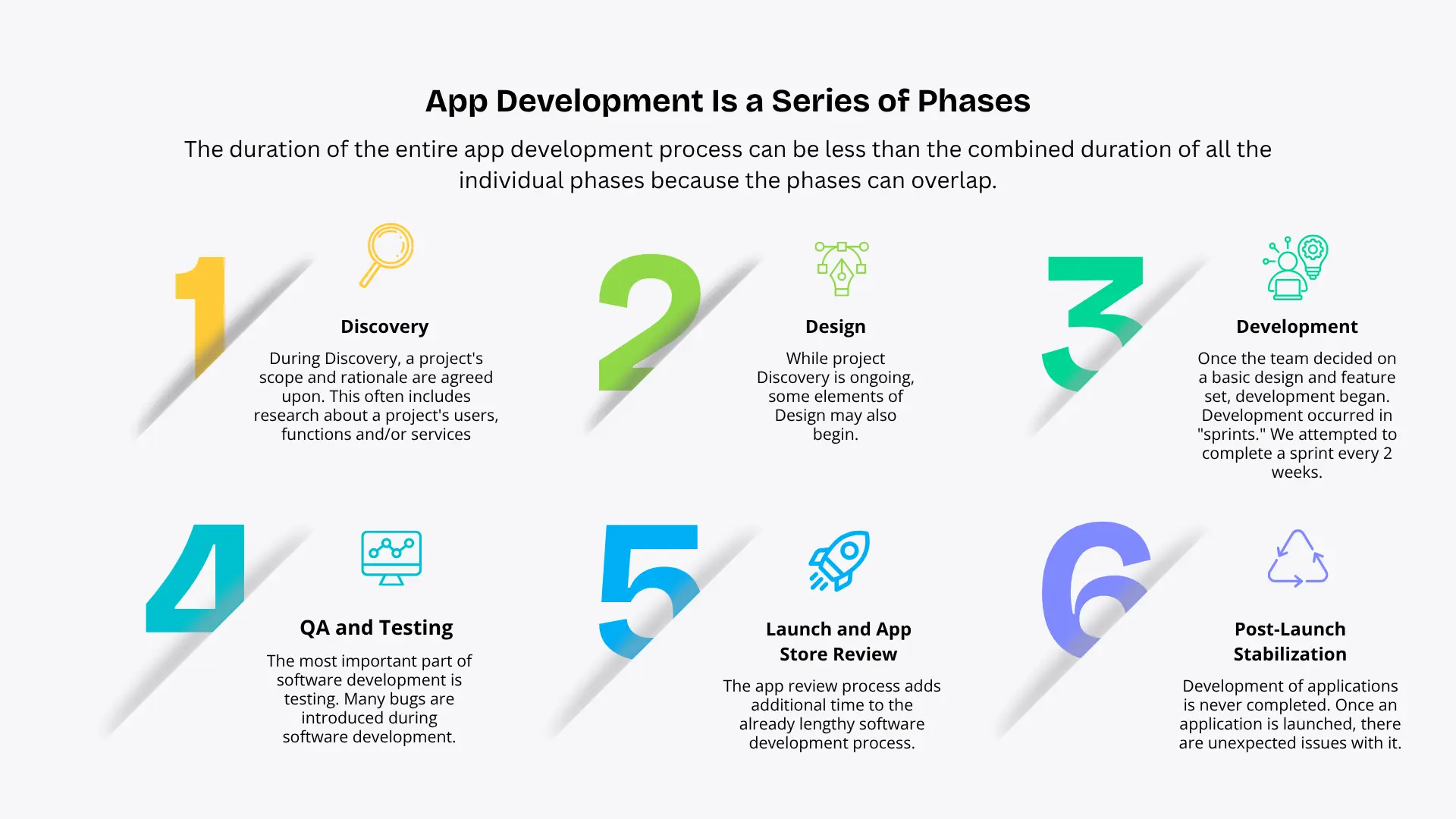
The duration of the entire app development process can be less than the combined duration of all the individual phases because the phases can overlap.
Phases Before the Starting Date
Generally, many potential clients contact an app development agency to hire a development partner just before the launch of a new product.
However, this can create delays because the process of deciding on a service partner takes time. That’s why it helps to know how to choose a development company before you start. Define your conditions in advance to identify the right experts. You’ll want to partner with a company that builds the application rather than outsources construction, and that provides consistent access to a build, rather than forcing you to rely on video updates. The scope of your project will dictate the length of time required to vet potential partners and will likely increase as your project nears launch.
Discovery
During Discovery, the team agrees on a project’s scope and rationale. This often includes research about a project’s users, functions and/or services. The step defines the course and limitations of the project. Depending upon the size and complexity of the project, this phase may take from a few weeks to a few months. At a minimum, Discovery provides a clear road map for the project, and often provides a preliminary evaluation of the project’s elements and operations.
Failure to engage in a thorough Discovery process will likely result in a redefinition and/or extension of the project.
Design
While project Discovery is ongoing, some elements of Design may also begin. The focus of Design is the creation of functional interfaces. Elements of Design may also be iterative and continuous. Once the Design phase has begun, the team must test prototypes and functioning systems to ensure they meet the requirements of the end user.
Revisions to Figma designs may take hours, while similar changes to functional systems may take days.
Development
Once the team decided on a basic design and feature set, the team began development. Development occurred in “sprints.” Our team attempted to complete a sprint every 2 weeks. At the same time we built the mobile app and the web app simultaneously. Developing the app took longer than we anticipated.
For a simple app, the process of writing the code for the back end and building the app’s user interface takes a while. As a result, we expect the entire development process to take much longer than we initially anticipated.
During development, we were vulnerable to scope creep. With each minor change, we had to modify and extend the app’s code and design to integrate the change. We expected that increasing the size of the development team would decrease the time it takes to complete the project. We were wrong. We needed to slow down to accommodate the new team members.
QA and Testing
The most important part of software development is testing. Many bugs are introduced during software development. The best practice is for development teams to run tests at the end of each sprint. Teams should run tests to evaluate software code and to verify that the software works with the different versions of the mobile computing platform.
We are proud to say that, with the exception of a couple of minor bugs, we did not find major issues while testing the app.
Launch and App Store Review
The app review process adds additional time to the already lengthy software development process. App review times have decreased in the last couple of years. However, the policies governing the app review process change with little notice. We suggest that you review Apple’s and Google’s policies and processes to determine the latest waiting times to expect for an app review.
The review processes have allowed us to release software that is relatively free of major bugs. However, we expect that the software may contain a number of minor bugs.
Post-Launch Stabilization
Development of applications is never completed. Once you launch an application, unexpected issues can arise.
This is true for all applications. Plan for the unexpected and have developers on-site for a short period of time after the launch. After that, plan for the normal release and update cycles.
A Sample MVP Development Schedule
Generally, the development of an MVP takes somewhere between 3 and 5 months. In practice, many, if not all, of the development tasks in an MVP overlap. This is the case even for the earliest and latest tasks in the development. For example, during the earliest development tasks, the back end of the application may be configured and developed before the front end of the application is even designed. Additionally, the first tasks of the development may include testing and preparing beta versions of the application for distribution.
Features and Integrations
Some of the main factors that impact the development of an MVP are the features and integrations developed for it. Generally, you can reduce the scope of the first release by eliminating features that are not essential for the typical use of the application.
Platform Choice
Building both the iOS and the Android versions of an app can take a lot of time because you have two codebases. However, apps that require a lot of computation or usage of device hardware should be built natively. If the app is simple, a progressive web app can be built faster.
In most cases, businesses building apps require an easier technology stack and more business logic. So, Flutter and React Native are comparable for building apps faster than building native apps. In case the app requires deep integration with device hardware and/or heavy computation, building the app natively is preferable.
Team Size and Structure
A smaller team with a project manager is often more productive than a larger team, due to the need for longer coordination in the larger team. Productivity is often negatively correlated with team size. From a productivity standpoint, it is ideal to have people in the core team who cover the various roles of software development (dev, QA, PM).
US Compliance Requirements
Our team has extensive experience building apps, including healthcare and other apps involving sensitive data. Because of this, we are conscious of compliance requirements when developing software.
Depending on the software, several requirements may apply. Here are a few:
- Apps that handle protected health information on behalf of healthcare organizations need to comply with HIPAA.
- If the app stores, processes, or transmits payment card data, it must comply with the Payment Card Industry Data Security Standard (PCI DSS).
- Enterprise customers may require compliance with the Service Organization Control (SOC) 2 standard.
- An app should be usable by people with disabilities, and therefore should be developed with Americans with Disabilities Act (ADA) accessibility requirements in mind.
There are several considerations, and depending on the complexity of the requirements, there could be a substantial impact on the schedule. HealthTech apps illustrate the need to consider compliance requirements during the early stages of development.
Decision Speed
This is also called “management bandwidth.” There is usually only one person making the key decisions. The person making these decisions also determines how quickly feedback is provided to the development team. Agreeing on a time frame for feedback accelerates the development process.
Timeline by App Type
A social or marketplace app has the potential to take as long as a HealthTech app to develop and test. Similarly, an on-demand or e-commerce app could take several months to develop and test, depending on its features and complexity.
Fintech product development is particularly challenging. Our other product lines take about the same amount of time as the core development work. The payment security, identity verification, and audit readiness features result in a significant increase in the effort and time for testing.
How AI Changes Timelines
AI can either increase or reduce the time needed to develop an app, depending on whether it is being used as a feature within the app or as a tool to support the development process.
Impact of Incorporating AI Features
Development time increases if features such as a chatbot or recommendation engine have to be implemented. AI can fail in certain edge cases, and it is the developer’s responsibility to address these cases. As a result, incorporating AI in mobile app development extends the development time.
Effect of Using AI on Other Development Phases
AI in software development has the potential to automate numerous mundane and repetitive tasks, for example, code generation and unit test automation. While this increases the velocity of software development, numerous other aspects of software development, especially the less defined and structured phases, remain.
How to Estimate the Development Time for Your Project
There are five steps to complete this estimate.
- Identify the features your product provides and categorize them as must-have or nice-to-have.
- Identify the core phases of development, that is, discovery, design, development, and testing.
- Subtract the time that is spent working on the same feature (overlap). For example, design and development overlap.
- Factor in additional time for compliance, for example, HIPAA or PCI DSS.
- Factor in additional time to account for uncertainties. Ask your development partner for this time estimate.
You only get to do the first part of this exercise with your essential features. In the second part, you get to include your nice-to-have features. The difference between the two shows the real, time-related cost of your wish list.
Why Do Project Timelines Slip?
There are a number of recurring causes. These include:
- Scope creep: The addition of new features during development.
- Slow feedback: Establish feedback turnaround times at the start of the project.
- Fuzzy functions: The definition of the features being developed is unclear.
- Last-minute testing: Testing should happen at the end of each sprint.
- Store rejections: Read the guidelines before submitting.
Ultimately, treating the buffer as part of the plan helps maintain a realistic schedule.
Time, Cost, and Quality
Mobile app development cost in the USA is commonly estimated to cost between $20,000 and $100,000, depending on scope, features, and compliance needs. Projects at the lower end of that range often have compressed timelines or reduced scope, especially if you want to maintain quality. Usually, you can only manage to control two of these three constraints without affecting the third.
Final Thoughts
No single number can represent all apps. A simple app can be developed and released in less than half a year. By contrast, complex apps, especially apps with Artificial Intelligence (AI) and products regulated by government bodies, can take over a year to develop and release. Factors affecting the length of the app development process include the app development company’s location and rate of decisions made, compliance rules, the number and complexity of apps being developed, and the platforms used for development.
Ultimately, the most important things to learn from this article are to verify what app development companies mean by “short” and “long” when given development timelines, to expect that the app development company will take some time to organize and prepare for the development process, to keep the app’s first release as small as possible, and to expect that the app development company will take some time to finalize the app.
At CodeStore, we have found that the development of regulated apps can take longer due to the app development company and the regulatory agency finalizing requirements and app features. Using the template provided in this article, you can gain a rough estimate of the time it will take to develop your regulated app and provide your app development company with a timeline.