
table of content
- What to Know Before Choosing Your App Development Partner?
- What Projects Have You Had to Change?
- Who Will Actually Work on My Project?
- What Would You Cut, Delay, or Challenge in My Current Feature List?
- What Assumptions Are Baked Into Your Estimate?
- What Happens When Something Unexpected Comes Up?
- Who Makes the Call When We Disagree?
- How Will You Prove That the App Is Ready to Launch?
- What Do I Own and Control the Day After Handover?
- What Happens If I Need to Replace Your Team Six Months After Launch?
- What Would Make You Tell Me Not to Build This App Yet?
- A Prioritized List of Things to Review Prior to Signing an Agreement
- Red Flags
- The Importance of the Questions During Proposal Review
- Conclusion
- Frequently Asked Questions


10 Questions to Ask Before Hiring a Mobile App Development Company
What to Know Before Choosing Your App Development Partner?
Selecting the right app development partner goes far beyond comparing development skills and rates. Potential partners may have strong portfolios, but the work shown on a website doesn’t always reveal how an agency handles changing requirements, unexpected problems, or issues that arise after development is completed.
If you are considering a mobile app development company in USA, the answers you receive before signing a partnership can reveal how the team handles challenges during development and responds when unexpected issues arise.
The following questions may help you move past the sales pitch.
What Projects Have You Had to Change?
Usually development agencies showcase successful project launches. While this illustrates the capabilities of the agency, it often does not illustrate how the development team copes with unexpected changes or challenges.
There are usually a multitude of challenges that occur during development and unexpected things that happen. It is helpful to understand how the development team analyzes and copes with changes.
Different types of information are available at different levels of abstraction. Usually, describing a product in detail provides more context than a collection of screenshots. The EduZone app, for example, supports different user roles and interactions designed around different learning needs.
While describing challenges provides more context than “There were a few challenges”, challenges provide little context and determining the team’s final behavior from that description is nearly impossible.
Who Will Actually Work on My Project?
One of the best challenges for determining behavior is asking who will work on the project after the contract is signed. There are many people who touch a deal, and while they may provide valuable feedback and help get the project across the finish line, they may not be involved in the project at all after the contract is signed.
You need to identify the project’s manager and the person or people who will write the code. It is also good to know whether they are employees of the vendor or subcontractors. You should know the level of involvement of the lead engineers, and if they leave, who will replace them.
You should be able to meet the person who will write the code and review the design before the project starts.
If the proposal does not name the people in the job titles listed in the proposal, you should know who they are.
What Would You Cut, Delay, or Challenge in My Current Feature List?
It is very easy for a software development company to say yes to a requirements document. It is more interesting to consider what the minimum viable product (MVP) should be.
You will likely have to integrate a number of user roles, build several dashboards, provide different types of notifications, create an admin panel, and/or build integrations. Not all of these features need to be in the first version of the product.
Consider what the development team would question or postpone and why.
Postponing or questioning aspects of the scope implies that the development team is considering trade-offs to meet the requirements. It also indicates that the team understands the features of the product being developed and how they relate to each other. Considering these trade-offs and requirements allows you to determine the minimum product that can be released to the customer.
If the development team believes it is necessary to implement the product, the team should provide a reason. If postponing or removing the feature is allowed, the team should also provide a reason.
What Assumptions Are Baked Into Your Estimate?
Breaking even or making a small profit on a project depends on the assumptions a software development company makes regarding the project. What are the assumptions that your software development company has made for the feature cost estimate?
Two different companies may interpret the same requirements differently and, as a result, develop an entirely different solution. One solution may include substantial backend work and integrations, while the other may not. Each may be justified in their interpretation.
To understand costs, it is essential to understand what is and what is not included in the proposal. Further, it is important to understand what can cause the costs to change.
Proposals should be clear regarding the costs associated with different features. Costs associated with different features may be clearly defined; however, there may be several aspects of the solution which are not clearly defined.
Providing estimates is the nature of the business; however, the purpose of the estimate may vary.
Generally, an estimate should include features, the platforms on which the features are to be implemented, how the features are to be designed and implemented, integrations and dependencies, testing, deployments, and what support will be provided once the features are deployed.
An estimate should include exclusions. Understanding what is not included may provide insight into potential areas where the scope of the project may expand.
What Happens When Something Unexpected Comes Up?
Development work is unpredictable and, at times, the unexpected may occur.
An API may not provide an essential capability. A service may change its behavior. A function may be implemented differently on various devices. A business requirement may not be supported as specified in the implementation. You may discover the unexpected.
What happens in these cases?
The ability to describe the issue, the options, and the trade-offs is crucial. Often the constraints of time and budget determine the ultimate decision.
Integrating various systems, especially with external parties, requires the evaluation of business risks and trade-offs. Understanding the A-Z guide to third-party APIs can help with understanding the overall process.
There are standard processes and then there is the reality of actual situations. Describing a process may provide little value. Understanding what actually happens behind the scenes, particularly in a pressure situation, can help build trust.
Who Makes the Call When We Disagree?
When there is a disagreement between your business requirements and the preferences of the engineering team, ask how they resolve similar situations. Often, both situations may appear similar, but there is usually a good reason for the recommendation.
The team should be able to articulate the pros and cons of various options and talk about the impacts of each. For example, the impact of a particular design choice may be around performance, security, ease of maintenance, ease of development, and how well the software scales. Impact may also be around costs to operate the software.
Are design decisions documented? If more than one person works on a given design, it may be useful to document the rationale to capture the design decision.
You make the business decisions. The engineering decisions, however, should be justified to you.
How Will You Prove That the App Is Ready to Launch?
What does the company consider to be software testing and Quality Assurance (QA)? Ask the company to describe the types of software testing and QA they perform and how they determine whether the app is ready for release.
What is your process for assuring the software meets the requirements for security? Is your team using the Mobile Application Security Verification Standard (MASVS) or a similar standard?
What will you get upon release? This is what you should ask to evaluate whether to release the software. You could receive test results, a release checklist, a staging build, a list of defects, or acceptance criteria.
We should discuss the differences in the platforms supported, since the requirements of each of the platforms change. Because Apple and Google regularly update their app submission and target API requirements, ask the development company how these changes will be monitored and who will handle required updates. Google Play requires new app submissions to be built for Android 16 (or higher), while apps targeted for Android 15 (or higher) are required to retain their availability for all newer Android devices. Please refer to the Google Play target API level requirements for the latest requirements.
Since these requirements change, it is important to clarify during the employment process who will manage these requirements, and whether support for these changes will be included in the support agreement.
What Do I Own and Control the Day After Handover?
It is easier to define ownership for the assets developed prior to the software release. The definition could include the software code, server code, server software, documents, drawings, data, domain names, web sites, online accounts, and/or third-party services.
Certain open-source elements have terms and conditions on their usage that require review.
An interesting question is, “If our relationship terminated, what would be our leak-out and our leak-back situations?”
Leak-out refers to information that you no longer possess but which the service provider still controls. Leak-back refers to information which the service provider no longer has but which you still control.
The best case scenario is to have information that outlines the components of a given service and the elements that you control. You should also be able to describe the elements for which you still rely on the service provider for support.
What Happens If I Need to Replace Your Team Six Months After Launch?
The situation today may not be the situation in the future. You may no longer need your development partner, or you may no longer need the application itself. You may spin off your development partner’s function and expand your business by acquiring or merging with another business.
For all these reasons, it is important to consider the situations where you may need to terminate your relationship with your development partner.
For the situations where termination is necessary, you should also consider the situation where another development partner takes over the application. The terms and conditions of the contract should outline the information needed to deploy and maintain the application.
The E-Library application provides a case where an application is designed in such a way that it can be used to serve various types of content and fulfill various access requirements. You should be able to derive several questions from this case, including how to obtain and evaluate product support and maintenance information.
You can ask if the company has ever transferred a project to another team. If so, what was the process like? Being able to reference a real-world example of a handover process is ideal.
If you believe the company will be your long-term support and maintenance partner, ask about software support and maintenance to better understand what this support will entail.
What Would Make You Tell Me Not to Build This App Yet?
For the development of this app, what would the company require to support a go-ahead?
Keep in mind that the potential user base for the app may not have been assessed, and/or a key partner/supporting app may not have been assessed. There may also be other aspects of the business which remain undefined.
A development company may identify risks that, if not evaluated, could create larger problems for the project or affect its overall success.
The recommendation may be to perform a smaller, less risky assessment of the project, which may include a proof of concept (POC), minimum viable product (MVP) release, or other risk assessments.
A Prioritized List of Things to Review Prior to Signing an Agreement
After discussing your project with development companies, compare what they said they would need to see to support a go-ahead with development. The focus of the comparison should be on what the development process will be, not how much it will cost.
| Evaluation Area | What to Verify | Evidence to Request |
| Team | Written details of individuals and roles, and employment status | Team’s organizational structure and CVs |
| Experience | Do they have real world examples of work challenges? | Examples of projects they have worked on |
| Product Management | Will they challenge “must have” product features? | Examples of product feature justification |
| Estimation | Have they captured the rationale and given an estimate range? | Definition of scope and business case justification |
| Change Management | Is unexpected work formalized? | Change Request / Change Management Process |
| Technical Decision Making | Do they express trade-offs? | Architecture Decision Records |
| Quality | Is a release checklist available? | Test Plan / Test Case / Release Readiness Checklist |
| Ownership | Will the contract specify access and ownership of assets? | Contract clause defining ownership/access of code, assets & accounts |
| Handover | Could the work be completed by another team using only documentation? | Documentation / Processes |
| Business Judgment | Will they suggest a wait scenario to clients? | Example of a suggested client project/business activity/service/product/feature satisfaction or validation |
Use the provided formats to capture information during interviews, focusing on example details.
Red Flags
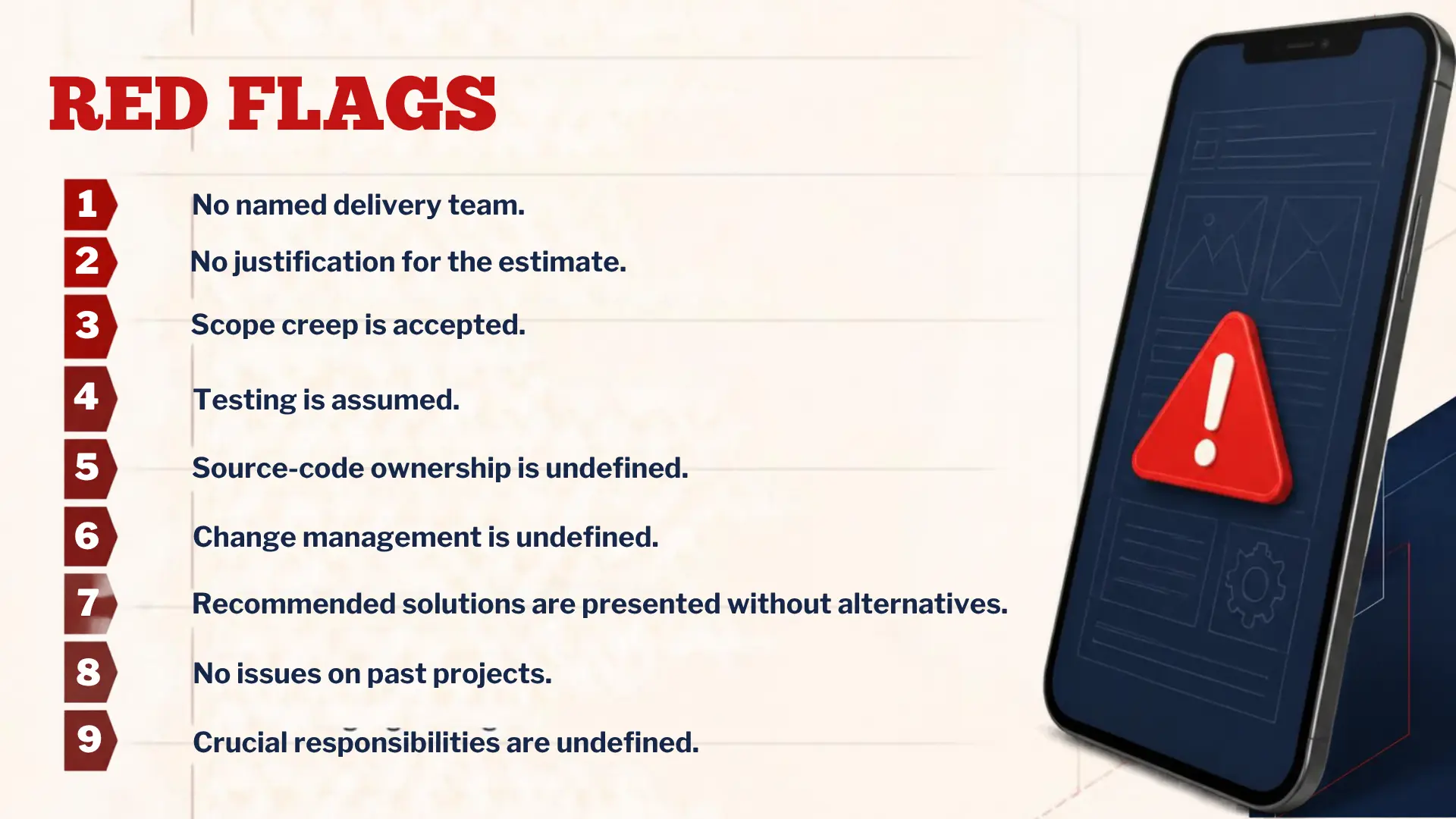
- No named delivery team: If the company is unable to disclose the individuals that will lead the project, it is imperative that you request this information prior to signing the contract.
- No justification for the estimate: Quotes do not sufficiently describe the scope of the work. There will inevitably be work items that are outside the quoted work.
- Scope creep is accepted: Find out what work will be simplified or delayed to make room for the quoted work. Also, ask what work will be included in the first release.
- Testing is assumed: Identify what, when and how testing will be performed and what documentation will be provided to you prior to release.
- Ownership of the source code is not defined: The contract should define ownership of the code, servers, and other deliverables.
- Change management is not defined: There should be documented processes to manage change.
- Recommended solutions are provided: Ask what other solutions were considered.
- No issues were experienced on past projects: What kind of issues occurred and how did the team learn from this?
- Things that are crucial to the project are not defined: If ownership or support of a work item is crucial to your project, it should be defined in the contract.
The Importance of the Questions During Proposal Review
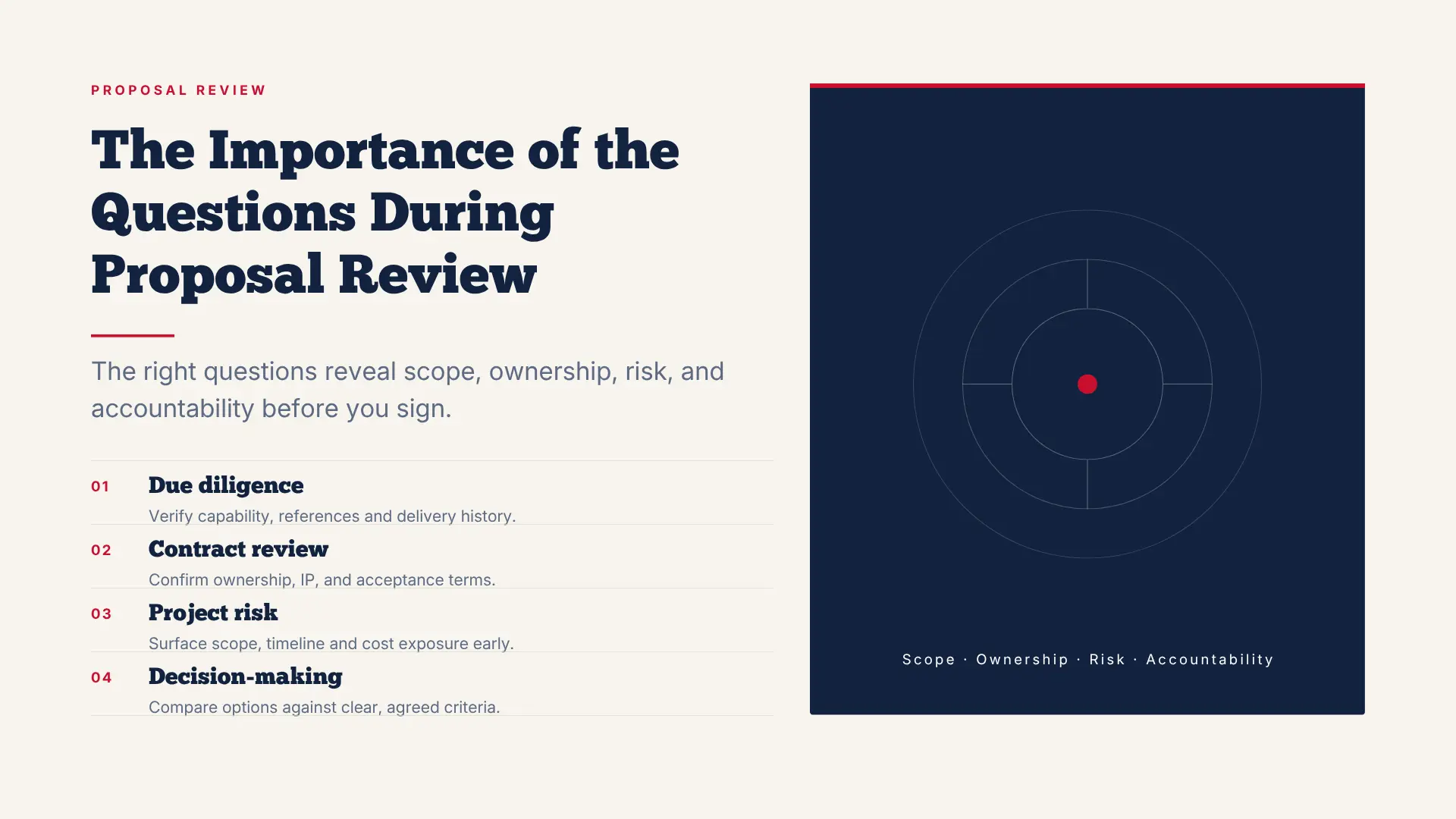
When evaluating a service provider, proposals and sales presentations help paint a picture of what the team wants to accomplish. However, these documents rarely provide insight into how a team manages the unknown, such as changing requirements and unexpected limitations.
Prior to contract execution, you should be able to answer the following. Who will ultimately make the product? Who or what will make the final call on product trade-offs? How will changes be prioritized? What will be supported post product launch? Who will own the product?
You should be evaluating the same when you review a proposal. Focus on the levels of uncertainty, the framework and rationale for technical decisions, and the support structure. The focus of your analysis should help differentiate development partners, and help you understand how each partner will approach a product, and not how the partner will present a given service offering.
For businesses planning a mobile product, reviewing relevant mobile app development guides can help clarify project requirements, technical considerations, and partner expectations.
Conclusion
Choosing a mobile app development company involves more than comparing portfolios, estimates, or technical capabilities. The questions you ask before signing an agreement can help you understand how a development team approaches requirements, technical decisions, unexpected changes, testing, ownership, and long-term support.
A development partner should be able to explain its decisions, identify potential risks, and provide clear information about the people, processes, and responsibilities involved in the project.
For businesses looking for a mobile app development company, these questions can provide a practical framework for evaluating potential partners and understanding what to expect throughout the development process.
At CodeStore, we believe that understanding these details early can help establish clearer expectations and a more structured development process.
Frequently Asked Questions
table of content
- What to Know Before Choosing Your App Development Partner?
- What Projects Have You Had to Change?
- Who Will Actually Work on My Project?
- What Would You Cut, Delay, or Challenge in My Current Feature List?
- What Assumptions Are Baked Into Your Estimate?
- What Happens When Something Unexpected Comes Up?
- Who Makes the Call When We Disagree?
- How Will You Prove That the App Is Ready to Launch?
- What Do I Own and Control the Day After Handover?
- What Happens If I Need to Replace Your Team Six Months After Launch?
- What Would Make You Tell Me Not to Build This App Yet?
- A Prioritized List of Things to Review Prior to Signing an Agreement
- Red Flags
- The Importance of the Questions During Proposal Review
- Conclusion
- Frequently Asked Questions
10 Questions to Ask Before Hiring a Mobile App Development Company
What to Know Before Choosing Your App Development Partner?
Selecting the right app development partner goes far beyond comparing development skills and rates. Potential partners may have strong portfolios, but the work shown on a website doesn’t always reveal how an agency handles changing requirements, unexpected problems, or issues that arise after development is completed.
If you are considering a mobile app development company in USA, the answers you receive before signing a partnership can reveal how the team handles challenges during development and responds when unexpected issues arise.
The following questions may help you move past the sales pitch.
What Projects Have You Had to Change?
Usually development agencies showcase successful project launches. While this illustrates the capabilities of the agency, it often does not illustrate how the development team copes with unexpected changes or challenges.
There are usually a multitude of challenges that occur during development and unexpected things that happen. It is helpful to understand how the development team analyzes and copes with changes.
Different types of information are available at different levels of abstraction. Usually, describing a product in detail provides more context than a collection of screenshots. The EduZone app, for example, supports different user roles and interactions designed around different learning needs.
While describing challenges provides more context than “There were a few challenges”, challenges provide little context and determining the team’s final behavior from that description is nearly impossible.
Who Will Actually Work on My Project?
One of the best challenges for determining behavior is asking who will work on the project after the contract is signed. There are many people who touch a deal, and while they may provide valuable feedback and help get the project across the finish line, they may not be involved in the project at all after the contract is signed.
You need to identify the project’s manager and the person or people who will write the code. It is also good to know whether they are employees of the vendor or subcontractors. You should know the level of involvement of the lead engineers, and if they leave, who will replace them.
You should be able to meet the person who will write the code and review the design before the project starts.
If the proposal does not name the people in the job titles listed in the proposal, you should know who they are.
What Would You Cut, Delay, or Challenge in My Current Feature List?
It is very easy for a software development company to say yes to a requirements document. It is more interesting to consider what the minimum viable product (MVP) should be.
You will likely have to integrate a number of user roles, build several dashboards, provide different types of notifications, create an admin panel, and/or build integrations. Not all of these features need to be in the first version of the product.
Consider what the development team would question or postpone and why.
Postponing or questioning aspects of the scope implies that the development team is considering trade-offs to meet the requirements. It also indicates that the team understands the features of the product being developed and how they relate to each other. Considering these trade-offs and requirements allows you to determine the minimum product that can be released to the customer.
If the development team believes it is necessary to implement the product, the team should provide a reason. If postponing or removing the feature is allowed, the team should also provide a reason.
What Assumptions Are Baked Into Your Estimate?
Breaking even or making a small profit on a project depends on the assumptions a software development company makes regarding the project. What are the assumptions that your software development company has made for the feature cost estimate?
Two different companies may interpret the same requirements differently and, as a result, develop an entirely different solution. One solution may include substantial backend work and integrations, while the other may not. Each may be justified in their interpretation.
To understand costs, it is essential to understand what is and what is not included in the proposal. Further, it is important to understand what can cause the costs to change.
Proposals should be clear regarding the costs associated with different features. Costs associated with different features may be clearly defined; however, there may be several aspects of the solution which are not clearly defined.
Providing estimates is the nature of the business; however, the purpose of the estimate may vary.
Generally, an estimate should include features, the platforms on which the features are to be implemented, how the features are to be designed and implemented, integrations and dependencies, testing, deployments, and what support will be provided once the features are deployed.
An estimate should include exclusions. Understanding what is not included may provide insight into potential areas where the scope of the project may expand.
What Happens When Something Unexpected Comes Up?
Development work is unpredictable and, at times, the unexpected may occur.
An API may not provide an essential capability. A service may change its behavior. A function may be implemented differently on various devices. A business requirement may not be supported as specified in the implementation. You may discover the unexpected.
What happens in these cases?
The ability to describe the issue, the options, and the trade-offs is crucial. Often the constraints of time and budget determine the ultimate decision.
Integrating various systems, especially with external parties, requires the evaluation of business risks and trade-offs. Understanding the A-Z guide to third-party APIs can help with understanding the overall process.
There are standard processes and then there is the reality of actual situations. Describing a process may provide little value. Understanding what actually happens behind the scenes, particularly in a pressure situation, can help build trust.
Who Makes the Call When We Disagree?
When there is a disagreement between your business requirements and the preferences of the engineering team, ask how they resolve similar situations. Often, both situations may appear similar, but there is usually a good reason for the recommendation.
The team should be able to articulate the pros and cons of various options and talk about the impacts of each. For example, the impact of a particular design choice may be around performance, security, ease of maintenance, ease of development, and how well the software scales. Impact may also be around costs to operate the software.
Are design decisions documented? If more than one person works on a given design, it may be useful to document the rationale to capture the design decision.
You make the business decisions. The engineering decisions, however, should be justified to you.
How Will You Prove That the App Is Ready to Launch?
What does the company consider to be software testing and Quality Assurance (QA)? Ask the company to describe the types of software testing and QA they perform and how they determine whether the app is ready for release.
What is your process for assuring the software meets the requirements for security? Is your team using the Mobile Application Security Verification Standard (MASVS) or a similar standard?
What will you get upon release? This is what you should ask to evaluate whether to release the software. You could receive test results, a release checklist, a staging build, a list of defects, or acceptance criteria.
We should discuss the differences in the platforms supported, since the requirements of each of the platforms change. Because Apple and Google regularly update their app submission and target API requirements, ask the development company how these changes will be monitored and who will handle required updates. Google Play requires new app submissions to be built for Android 16 (or higher), while apps targeted for Android 15 (or higher) are required to retain their availability for all newer Android devices. Please refer to the Google Play target API level requirements for the latest requirements.
Since these requirements change, it is important to clarify during the employment process who will manage these requirements, and whether support for these changes will be included in the support agreement.
What Do I Own and Control the Day After Handover?
It is easier to define ownership for the assets developed prior to the software release. The definition could include the software code, server code, server software, documents, drawings, data, domain names, web sites, online accounts, and/or third-party services.
Certain open-source elements have terms and conditions on their usage that require review.
An interesting question is, “If our relationship terminated, what would be our leak-out and our leak-back situations?”
Leak-out refers to information that you no longer possess but which the service provider still controls. Leak-back refers to information which the service provider no longer has but which you still control.
The best case scenario is to have information that outlines the components of a given service and the elements that you control. You should also be able to describe the elements for which you still rely on the service provider for support.
What Happens If I Need to Replace Your Team Six Months After Launch?
The situation today may not be the situation in the future. You may no longer need your development partner, or you may no longer need the application itself. You may spin off your development partner’s function and expand your business by acquiring or merging with another business.
For all these reasons, it is important to consider the situations where you may need to terminate your relationship with your development partner.
For the situations where termination is necessary, you should also consider the situation where another development partner takes over the application. The terms and conditions of the contract should outline the information needed to deploy and maintain the application.
The E-Library application provides a case where an application is designed in such a way that it can be used to serve various types of content and fulfill various access requirements. You should be able to derive several questions from this case, including how to obtain and evaluate product support and maintenance information.
You can ask if the company has ever transferred a project to another team. If so, what was the process like? Being able to reference a real-world example of a handover process is ideal.
If you believe the company will be your long-term support and maintenance partner, ask about software support and maintenance to better understand what this support will entail.
What Would Make You Tell Me Not to Build This App Yet?
For the development of this app, what would the company require to support a go-ahead?
Keep in mind that the potential user base for the app may not have been assessed, and/or a key partner/supporting app may not have been assessed. There may also be other aspects of the business which remain undefined.
A development company may identify risks that, if not evaluated, could create larger problems for the project or affect its overall success.
The recommendation may be to perform a smaller, less risky assessment of the project, which may include a proof of concept (POC), minimum viable product (MVP) release, or other risk assessments.
A Prioritized List of Things to Review Prior to Signing an Agreement
After discussing your project with development companies, compare what they said they would need to see to support a go-ahead with development. The focus of the comparison should be on what the development process will be, not how much it will cost.
| Evaluation Area | What to Verify | Evidence to Request |
| Team | Written details of individuals and roles, and employment status | Team’s organizational structure and CVs |
| Experience | Do they have real world examples of work challenges? | Examples of projects they have worked on |
| Product Management | Will they challenge “must have” product features? | Examples of product feature justification |
| Estimation | Have they captured the rationale and given an estimate range? | Definition of scope and business case justification |
| Change Management | Is unexpected work formalized? | Change Request / Change Management Process |
| Technical Decision Making | Do they express trade-offs? | Architecture Decision Records |
| Quality | Is a release checklist available? | Test Plan / Test Case / Release Readiness Checklist |
| Ownership | Will the contract specify access and ownership of assets? | Contract clause defining ownership/access of code, assets & accounts |
| Handover | Could the work be completed by another team using only documentation? | Documentation / Processes |
| Business Judgment | Will they suggest a wait scenario to clients? | Example of a suggested client project/business activity/service/product/feature satisfaction or validation |
Use the provided formats to capture information during interviews, focusing on example details.
Red Flags
- No named delivery team: If the company is unable to disclose the individuals that will lead the project, it is imperative that you request this information prior to signing the contract.
- No justification for the estimate: Quotes do not sufficiently describe the scope of the work. There will inevitably be work items that are outside the quoted work.
- Scope creep is accepted: Find out what work will be simplified or delayed to make room for the quoted work. Also, ask what work will be included in the first release.
- Testing is assumed: Identify what, when and how testing will be performed and what documentation will be provided to you prior to release.
- Ownership of the source code is not defined: The contract should define ownership of the code, servers, and other deliverables.
- Change management is not defined: There should be documented processes to manage change.
- Recommended solutions are provided: Ask what other solutions were considered.
- No issues were experienced on past projects: What kind of issues occurred and how did the team learn from this?
- Things that are crucial to the project are not defined: If ownership or support of a work item is crucial to your project, it should be defined in the contract.
The Importance of the Questions During Proposal Review
When evaluating a service provider, proposals and sales presentations help paint a picture of what the team wants to accomplish. However, these documents rarely provide insight into how a team manages the unknown, such as changing requirements and unexpected limitations.
Prior to contract execution, you should be able to answer the following. Who will ultimately make the product? Who or what will make the final call on product trade-offs? How will changes be prioritized? What will be supported post product launch? Who will own the product?
You should be evaluating the same when you review a proposal. Focus on the levels of uncertainty, the framework and rationale for technical decisions, and the support structure. The focus of your analysis should help differentiate development partners, and help you understand how each partner will approach a product, and not how the partner will present a given service offering.
For businesses planning a mobile product, reviewing relevant mobile app development guides can help clarify project requirements, technical considerations, and partner expectations.
Conclusion
Choosing a mobile app development company involves more than comparing portfolios, estimates, or technical capabilities. The questions you ask before signing an agreement can help you understand how a development team approaches requirements, technical decisions, unexpected changes, testing, ownership, and long-term support.
A development partner should be able to explain its decisions, identify potential risks, and provide clear information about the people, processes, and responsibilities involved in the project.
For businesses looking for a mobile app development company, these questions can provide a practical framework for evaluating potential partners and understanding what to expect throughout the development process.
At CodeStore, we believe that understanding these details early can help establish clearer expectations and a more structured development process.